10 Lesser-Known Creatures from Indian Folklore
Table of Contents
You think you know Indian mythology.
Nagas, Rakshasas, Garuda, Yakshas — the usual lineup. The ones with Wikipedia pages and Amar Chitra Katha comics and Bollywood cameos. Those are fine. Respected. Famous for a reason.
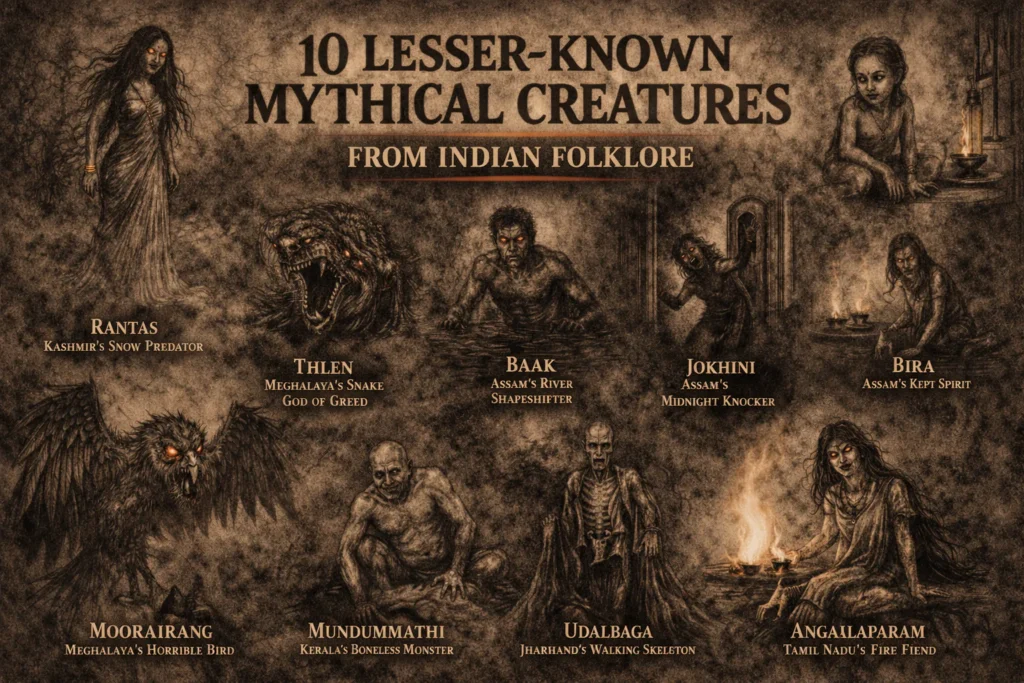
But India is not one mythology. It is three hundred mythologies stacked on top of each other — every state, every tribe, every river valley with its own archive of beings that the mainstream never got around to mentioning. The creatures in this list come from that archive. Some are ancient. Some are regional. Some are genuinely terrifying.
All of them have been waiting for someone to tell their story properly.
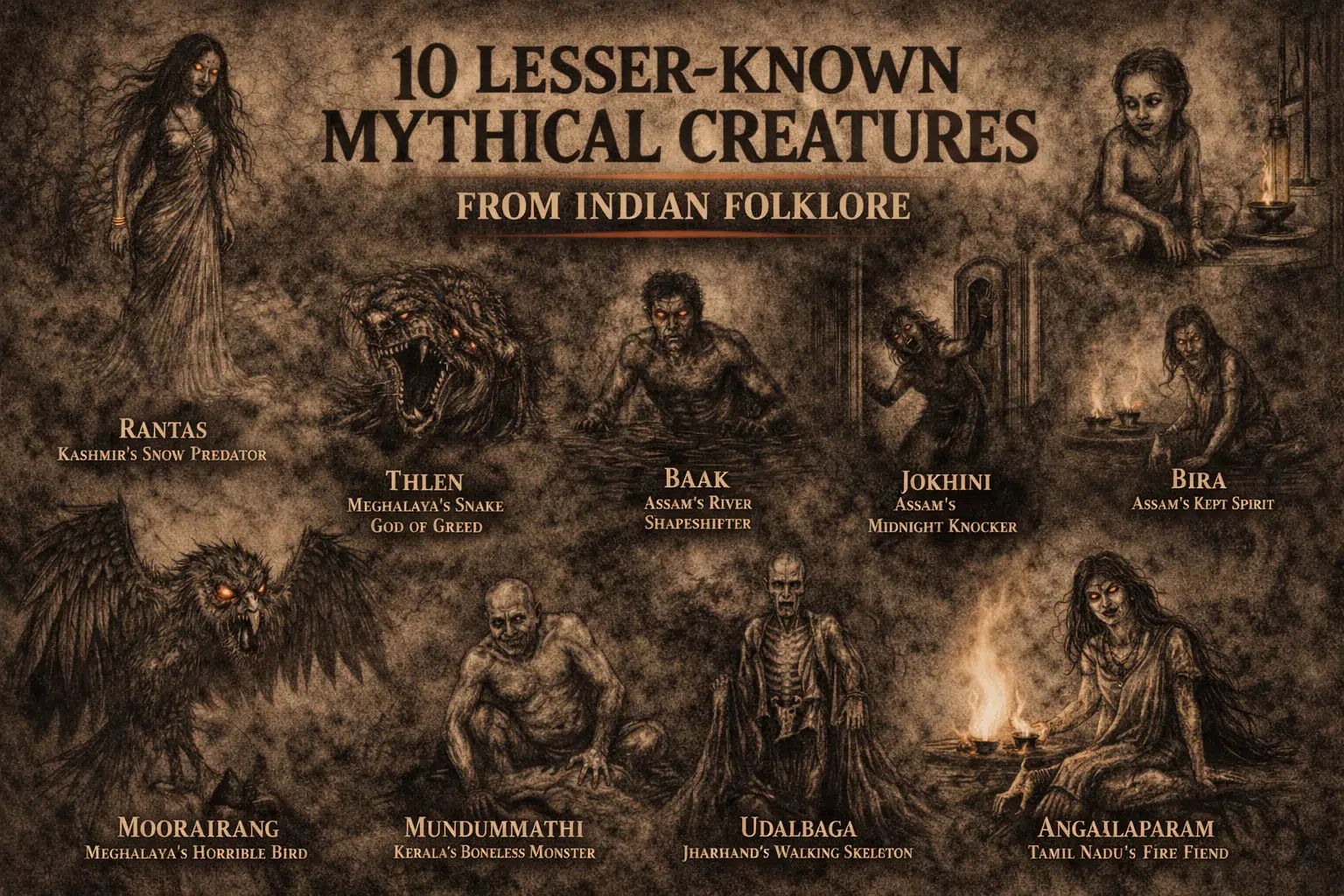
1. Rantas — Kashmir’s Snow Predator
Kashmir’s folklore has a creature that operates almost identically to the Churel of North India — but colder. Literally.
The Rantas is a female entity who wanders snow-covered forests on winter nights with long unkempt hair, sharp teeth, and feet turned backward. She disguises herself as a beautiful woman to lure men, then abducts them to a lair that no one has ever found or returned from to describe.
One of the most specific legends involves a man named Lav Lone, who was reportedly taken by the Rantas near the Nallah Ferozpora stream in Kashmir. The story is told with enough geographic specificity — the exact stream, the approximate forest — that it has the texture of something remembered rather than invented.
What makes the Rantas distinct from other similar beings is her environment. Most supernatural creatures in Indian folklore are tied to heat — dry riverbeds, burning ghats, summer nights. The Rantas owns the cold. The blizzard. The white silence of a Kashmiri winter where you genuinely cannot see the person three feet ahead of you.
In that landscape, a beautiful woman appearing from nowhere isn’t just supernatural. It’s impossible. And that impossibility, the Rantas legend says, is exactly the thing you should run from.
2. Thlen — Meghalaya’s Snake God of Greed
Deep in the folklore of the Khasi tribe of Meghalaya lives the Thlen — a massive serpent-like entity that is less a monster and more a corrupt transaction.
The original Thlen lived in a cave near the Daiñthlen Falls, ambushing travelers and spreading terror through the region. A brave man named U Suidnoh devised a plan to kill it — and he succeeded, cutting the Thlen into pieces and instructing the people to eat it so it could never return.
One person didn’t eat their piece. They kept it.
That piece of the Thlen became a spirit that could be “kept” by a family — fed, maintained, passed down through generations. In exchange, it brought wealth. The price? Human blood. The keeper of the Thlen had to provide it with victims — quietly, carefully, without anyone knowing.
The Thlen belief became so embedded in Khasi society that a specific social category emerged: Nongkynmaw, families suspected of keeping a Thlen. Being labeled one was a mark of deep social shame.
The Thlen is not a creature that attacks you from outside. It’s a creature that lives in your house, in your family’s secret, in the bargain your ancestor made that you inherited without consent. That’s a specific kind of horror that no jump scare can replicate.
3. Baak — Assam’s River Shapeshifter
The rivers of Assam have always been alive in a way that people who’ve only seen polite rivers cannot fully understand — shifting, flooding, swallowing whole villages in a single monsoon. In that context, the Baak makes complete sense.
The Baak is an aquatic spirit that terrorizes fishermen at night. It can possess its victims and then continue living in human form — going home with the person’s face, sleeping in their bed, eating their food, wearing their life.
The family never knows immediately. The possessed person looks right. Sounds right. But something is slightly off — too quiet, too watchful, eyes that rest on things for a moment too long.
By the time anyone is certain, the Baak has been living among them for weeks.
The Baak terror is less about the river attack and more about the aftermath — the question of whether the person who came home is actually the person who left. That particular dread of domestic replacement is one of the deepest fears folklore knows how to express, and the Baak wears it perfectly.
4. Jokhini — Assam’s Midnight Knocker
While the Baak takes people, the Jokhini disturbs them in a more targeted and specific way.
The Jokhini is a female spirit in Assamese folklore with a particular obsession: pregnant women. She appears at night — knocking on doors, appearing as a silhouette outside windows, sometimes calling out — specifically targeting homes where a woman is expecting.
She doesn’t necessarily enter. The presence itself is the horror. The knocking at 3 AM. The shape at the window that is wrong in a way you can feel before you can identify.
Like the Nishi Dak of Bengal, the Jokhini weaponizes the night hours when a pregnant woman is already at her most physically vulnerable and most alert to threat. The instruction embedded in the legend is clear and practical: don’t open the door at night during a pregnancy. Don’t answer. Don’t look.
The Jokhini is community protective instinct, expressed as folklore.
5. Bira — Assam’s Kept Spirit
Still in Assam, because the Northeast’s supernatural tradition is extraordinarily rich and criminally underrepresented in national conversations about Indian folklore.
The Bira is a spirit that can be deliberately cultivated — kept by an individual who feeds it regularly in exchange for wealth and advantage. Think of it as the Assamese equivalent of the Thlen, but more personal, less serpentine, and with a particularly nasty exit clause.
If you keep a Bira, feed it, maintain the relationship — it rewards you. Business improves. Luck turns. Things go your way.
If you stop feeding it, neglect it, or try to break the arrangement — it turns on you with violence that is described as proportional to how long it was fed and how suddenly it was abandoned.
The Bira legend has a specific social function: it explains sudden wealth in a community where sudden wealth has no obvious source. It also explains sudden, catastrophic downfall. The story of the Bira is always the story of a bargain that someone eventually couldn’t maintain — and what collecting looks like when the collector is supernatural.
6. Ichchhadhari Nag — The Snake That Wears Your Face
You’ve heard of Nagas. Everybody has. But the Ichchhadhari Nag is a specific and distinct creature that operates very differently from the royal serpent deities of Hindu mythology.
The Ichchhadhari Nag is a shape-shifting cobra — specifically, one that has lived for over a hundred years and developed the ability to take any human form it chooses. It can become your neighbor. Your lover. A sadhu at the temple. A child by the roadside.
The legend varies by region, but the most consistent version involves an Ichchhadhari Nag that falls in love with a human — usually across the expected gender lines, a female Nag taking male form or vice versa. The relationship is genuine. The feeling is real. But the secret is always discovered eventually, and the revelation always ends in either tragedy or transformation.
What makes the Ichchhadhari Nag compelling is that it’s one of the few shapeshifting creatures in Indian folklore that is not inherently malevolent. It doesn’t shift to hunt. It shifts to live among humans — which raises uncomfortable questions about what “real” means, and whether a hundred years of life earns you the right to a human face.
7. Makara — The Beast That Guards Every Threshold
17th century watercolour painting depicting Varuna astride the Makara.
The Makara appears on the doorways of temples across India — carved into stone, guarding entrances, featured on the banners of the god of love Kamadeva, serving as the vehicle of the river goddess Ganga.
You have almost certainly seen a Makara without knowing its name.
It is a composite creature — part crocodile, part fish, part elephant in various regional depictions — that represents the boundary between the known and the unknown, the safe and the dangerous, the human world and whatever lies beyond it. It is the original threshold guardian, older than most of the major mythological narratives it later got absorbed into.
The Makara is interesting precisely because it isn’t hiding in folklore — it’s carved into nearly every major temple in India. It’s one of the most visually present mythological creatures in the country. And almost no one knows its name or its meaning.
The most famous creature nobody has heard of.
8. Yali — Stronger Than Lions and Elephants
If you’ve visited any Dravidian temple in South India — particularly in Tamil Nadu — you’ve walked past the Yali dozens of times without anyone stopping to explain what it is.
The Yali appears on temple pillars, gateway towers, and processional vehicles as a rearing composite creature — lion’s body, elephant’s trunk, a ferocity that radiates from stone. It is described in tradition as more powerful than either the lion or the elephant separately — something that could defeat both.
It is a guardian, but not a gentle one. The Yali doesn’t stand at the temple door to welcome you. It stands there to make sure that whatever wants to enter understands the cost of trying.
In folk tradition away from the temple contexts, the Yali exists in forest stories as a creature that simply cannot be stopped by conventional means. Warriors who encounter it in legends don’t defeat it — they survive it, which is treated as achievement enough.
9. Vetala — The Corpse That Thinks
Illustration of King Vikramaditya encountering a vetala, from the Vetala Panchavimshati.
The Vetala is known to people who’ve read the Baital Pachisi — the twenty-five stories of King Vikramaditya and the corpse-spirit he carried on his back through a graveyard. But outside that specific literary context, the Vetala as a creature is deeply misunderstood and underappreciated.
The Vetala is a spirit that inhabits corpses. It hangs upside down from trees in cremation grounds. It has the ability to see past, present, and future simultaneously — which is why it speaks in riddles and stories rather than direct answers.
The Vikramaditya tales have the king carrying the Vetala-possessed corpse to a sorcerer, with the Vetala telling him a complex story each night and asking a question at the end. Vikramaditya, too intelligent to pretend ignorance, always answers — which breaks the silence condition and forces them to return to the beginning.
The Vetala isn’t trying to destroy Vikramaditya. It’s testing him. Evaluating his wisdom. A supernatural creature that specifically chooses to engage with the most intelligent human it can find and challenge them over and over — not out of malice, but out of something closer to respect.
That’s a more interesting horror figure than anything that just wants to eat you.
10. Kuttichatan — Kerala’s Mischievous Demon
Most supernatural beings in Indian folklore are categorized cleanly — malevolent, benevolent, or neutral. The Kuttichatan from Kerala refuses that categorization with what feels like deliberate stubbornness.
Kuttichatan means “little Chatan” — a minor deity or spirit figure in Kerala’s indigenous tradition that can be mischievous, helpful, troublesome, or dangerous depending entirely on how you treat it and what it decides about you.
Kuttichatan worship exists — families that propitiate it, maintain a relationship with it, keep it from becoming destructive. The offerings are specific. The rituals are inherited. And if the practice lapses, the Kuttichatan doesn’t simply leave — it makes its displeasure known through household disorder, illness, and the specific misfortune of small things going wrong constantly in ways that add up to something unbearable.
Unlike most horror entities that operate at maximum impact — appearing dramatically, delivering catastrophic results — the Kuttichatan is a slow accumulation. The cup that always falls off the shelf. The door that never latches properly. The child who won’t stop crying at 3 AM. The feeling that someone small and very unhappy is living in the corner of your house and has been there long enough to feel ownership of the space.
That very specific brand of domestic haunting is the Kuttichatan’s specialty. And it is, in its quiet way, one of the most unsettling things in this entire list.
What India’s Forgotten Creatures Tell Us
Look at these ten together and a pattern emerges.
The Thlen and the Bira are about what people do for wealth — the secret bargains, the inherited debts. The Jokhini and the Rantas are about the specific vulnerabilities of women and those who protect them. The Baak is about the terror of not recognizing your own people. The Vetala is about the relationship between intelligence and supernatural power.
Indian folklore didn’t invent these creatures to frighten children into good behavior. It invented them to process real things — economic anxiety, community trust, the danger of rivers and winter and dark forests, what happens when desire becomes obsession.
Every one of these beings is a question dressed as a monster.
And the questions haven’t stopped being relevant just because we stopped telling the stories.
India has enough forgotten creatures to fill a library. These ten are barely the surface. Every district has its own shadows — beings that don’t have English Wikipedia pages, that exist only in the memory of the people who grew up hearing about them. Those are the ones worth finding before the last person who remembers them is gone.
Also Read : 10 lesser known creatures no one talks about