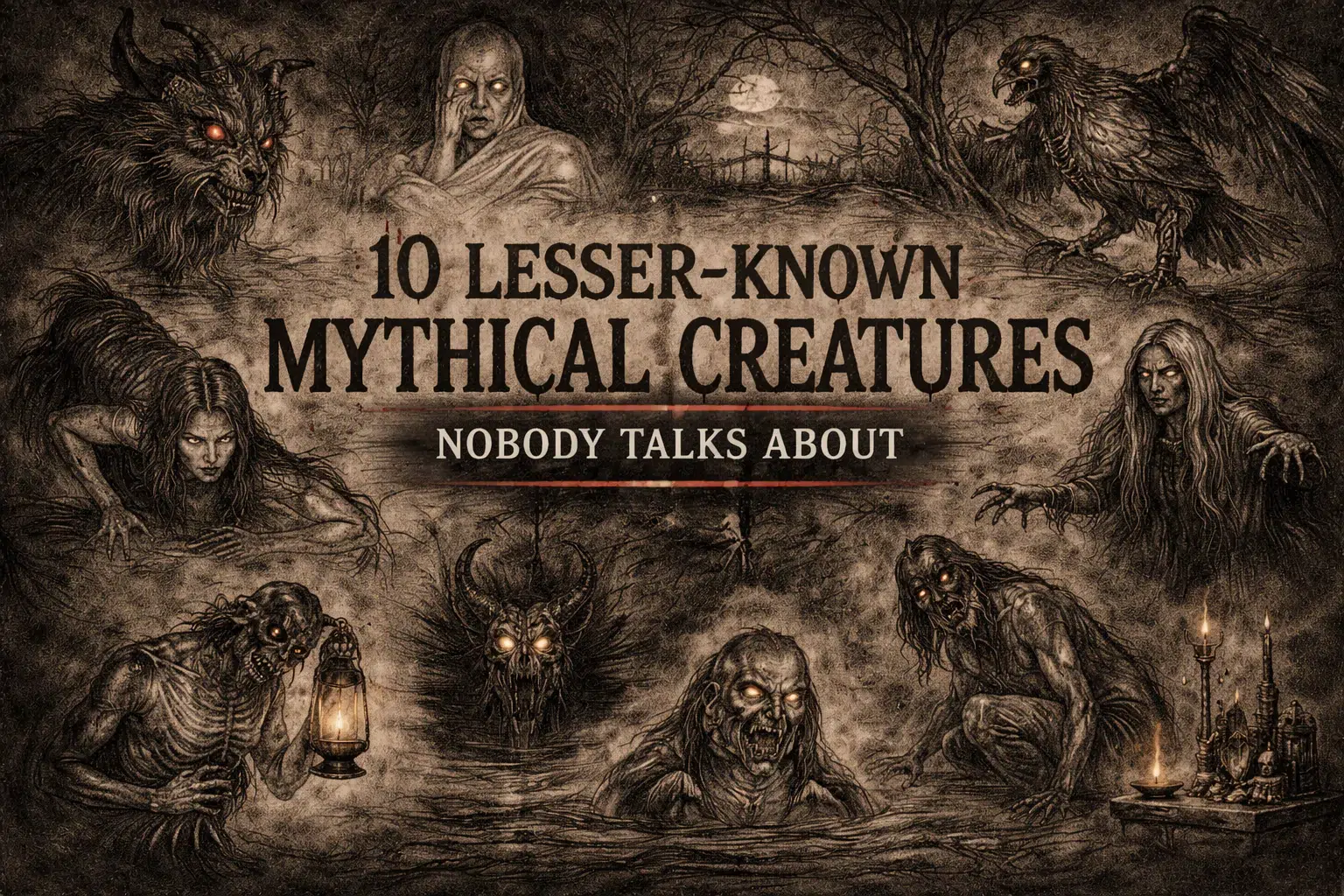
10 Lesser-Known Mythical Creatures Nobody Talks About
You already know the dragon. You’ve heard about the unicorn since you were six. Medusa, werewolf, vampire — these are the celebrities of the mythology world. They’ve got movies, merchandise, and dedicated Wikipedia rabbit holes.
But folklore is vast.
Every culture on earth, across every century of human existence, was busy inventing explanations for the things that scared them — and the deeper you go into that archive, the stranger, darker, and more fascinating it gets. These ten creatures exist in fully developed mythological traditions. They have rules, origin stories, and genuine cultural weight.
Nobody talks about them.
That changes today.
1. Bake-Kujira — Japan’s Ghost Whale
Imagine you are a fisherman off the Japanese coast. It’s night. The sea is flat. And then, moving just below the surface, you see a massive skeleton — a whale stripped entirely of flesh, bone glowing pale in the dark, surrounded by strange fish and unknown birds that shouldn’t exist.
That’s the Bake-Kujira. The ghost whale of Japanese folklore.
It doesn’t attack. It doesn’t chase you. It simply passes. Silent. Enormous. Wrong in the way only truly ancient things can be wrong.
The horror is in what follows. Every village, every fishing boat that encounters the Bake-Kujira and fails to pay it proper respect is said to receive a curse — disease, failed harvests, storms, fires. Misfortune in every form, for as long as the whale chooses to give it.
No claws. No roar. Just the slow passage of something dead that refused to finish dying, and the bill that arrives weeks later.
2. Trauco — Chile’s Footless Forest Dweller
Somewhere in the forests of Chiloé Island in southern Chile lives the Trauco — a dwarf with no feet, a grotesque face, a stone axe, and somehow, impossibly, irresistible charm.
He moves through the forest dragging himself on stumps, hammering his axe into trees to announce his presence. Women who encounter him fall under a hypnotic enchantment they cannot explain or resist.
The Trauco became the traditional explanation in Chiloé for any pregnancy that the community found inconvenient to discuss openly. Unmarried woman expecting a child? The Trauco. No further questions asked.
What makes the Trauco genuinely interesting is what his legend reveals — it’s folklore functioning as social protection, giving vulnerable women a supernatural explanation at a time when no other explanation was acceptable.
3. Amarok — The Inuit Giant Wolf
Most wolves in mythology hunt in packs. The Amarok of Inuit tradition hunts alone.
It is enormous — the size comparison to a regular wolf is roughly what a regular wolf is to a fox. It roams the Arctic tundra at night and has one specific, unsettling rule: it hunts people who hunt alone after dark. Not out of hunger necessarily. Almost as if it’s enforcing a law.
There’s a gentler side to Amarok too. In one Inuit legend, a boy who had been abandoned by his tribe — too weak to be kept — was found by the Amarok, who wrestled with him every night until the boy became strong enough to return home and survive.
The same creature that kills the foolish and the solitary, also strengthens the abandoned and the lost. That’s a more complex moral universe than most modern storytelling manages.
4. Indrik — Russia’s King of All Animals
The Indrik is one of Russian folklore’s most majestic forgotten creatures — a hybrid of bull’s body, deer’s legs, horse’s head, and a single horn like a unicorn.
It lives in the sacred mountains, far from human reach, and is considered the ruler of all animals. When it moves, the earth trembles. Rivers change course. Springs emerge where it walks.
But here’s the detail that sets the Indrik apart from every other “powerful animal king” archetype: it periodically sheds its horn and buries it. Nobody knows why. The horn is never found. It simply disappears into the earth, taking whatever power it carried with it.
A creature that voluntarily gives up its greatest weapon, on a schedule, for unknown reasons. There’s something almost philosophical about that.
5. Shirime — Japan’s… Eye. You’ll See.
Japanese folklore has a creature called the Shirime. It stops travelers on the road at night, appearing as a normal person, and asks politely where they’re going.
Then it bends over.
Where there should be nothing, there is a single enormous, perfectly functioning eye — staring directly at the terrified traveler.
That’s it. That’s the whole creature. It doesn’t eat people. It doesn’t curse them. Its entire existence is dedicated to the singular purpose of bending over and revealing the eye, at maximum psychological impact, to a stranger.
The name Shirime literally translates to “butt-eye.”
Japanese folklore is extraordinarily sophisticated and ancient and deeply spiritual, and then right in the middle of it there is the Shirime. It has been there for centuries. It will be there long after us.
6. Wolpertinger — Bavaria’s Most Adorable Nightmare
Bavaria in southern Germany has a forest creature that sounds like something a child designed on a fever dream afternoon — the Wolpertinger.
It has the body of a rabbit or hare, the wings of a bird, the antlers of a deer, and small, pointed fangs. It is said to be mischievous rather than dangerous, living in the Alpine forests and occasionally leading hunters astray.
The Wolpertinger is actually preserved in taxidermied form in the Deutsches Jagd und Fischereimuseum in Munich — where the museum displays a “specimen” with complete seriousness, straight-faced, next to legitimate natural history exhibits.
Bavaria leaned in. Fully. And honestly, respect.
7. Raijū — The Lightning Beast of Japan
Before you say anything: yes, this is the real-world inspiration for Pikachu. But the original Raijū is considerably more terrifying than a yellow cartoon mouse.
The Raijū is a creature of lightning — in various accounts described as a wolf, a cat, a weasel, or a ball of pure electrical energy. It travels inside lightning bolts and its cry is thunder itself. During storms it descends to earth and moves at incomprehensible speed, leaving scorch marks in the ground where it lands.
The specific folk belief around the Raijū involves sleeping with your stomach covered during thunderstorms — the Raijū is attracted to navels and may curl up in one to sleep. Which sounds absurd until you consider that it’s also a practical instruction to stay covered and warm during a dangerous storm.
Folklore has always been better at packaging safety advice than any government notice board.
8. Grootslang — South Africa’s Ancient Mistake
At the beginning of the world, according to South African legend, the gods made a terrible error.
They created a creature that was too powerful — impossibly strong, impossibly intelligent, impossibly cunning. The combination of attributes was dangerous. So they split it into two separate creatures: the elephant and the serpent.
But one original being escaped before the split could happen.
The Grootslang — Afrikaans for “great snake” — still lives, supposedly, in a deep cave system called the Wonder Hole in Richtersveld. It has the body of a massive snake and the head and forequarters of an elephant. It hoards diamonds — caves full of them — and will offer freedom to anyone it captures in exchange for precious gems.
A creature that is literally described as “too powerful to be allowed to exist” who escaped the gods’ attempt to fix their mistake. The Grootslang is mythology confronting the concept of divine fallibility, dressed as a monster.
9. Selkie — The Seal People of the North Atlantic
The Selkie comes from the folklore of Scotland, Ireland, and the Faroe Islands — and it is one of the most quietly heartbreaking creatures in any mythology, anywhere.
Selkies are seals in the ocean. On land, they shed their seal skin and become fully human — indistinguishable, beautiful, disoriented by gravity and dry air. If a human finds and hides a Selkie’s skin, the Selkie cannot return to the sea. They are trapped on land.
In almost every Selkie story, a man finds the skin of a female Selkie and hides it. She stays. They have children. She loves them. But she spends years searching every corner of the house, every field, every locked chest.
When she finally finds the skin — she goes back to the sea immediately. Not because she doesn’t love her family. Because the sea is what she is. And she was never given a choice about any of it.
Selkie folklore is about consent, captivity, and the part of a person that belongs to themselves and no one else. It has been quietly devastating for five hundred years and will continue to be.
10. Navagunjara — India’s Nine-Animal Being
Most people who grew up with Indian mythology know the major avatars, the main characters, the famous battles. Almost nobody outside of Odia tradition knows the Navagunjara.
It is a creature composed of nine different animals — the head of a rooster, the neck of a peacock, the back of a bull, the waist of a lion, the tail of a serpent, and the four legs of an elephant, tiger, deer, and human foot respectively. In one hand it holds a lotus.
Lord Krishna took this form to test Arjuna while he was hunting in the forest. Arjuna raised his bow at the terrifying composite creature — then recognized the divine in it and lowered his weapon. The test was whether he could see the sacred inside something that didn’t look like anything he had been taught to call sacred.
The Navagunjara is not a horror. It’s a philosophical argument made flesh. It is asking: can you recognize divinity when it doesn’t come in a familiar form?
That question is 2,000 years old and still not fully answered.
Why These Stories Matter
Here’s the thing that gets lost when we reduce mythology to entertainment or dismiss it as superstition — every single creature on this list came from a real community trying to explain something real. A fear. A social tension. A natural phenomenon. A moral question they didn’t have language for yet.
The Bake-Kujira is about the ocean’s indifference and the cost of disrespect. The Selkie is about ownership and identity. The Trauco is about protection and shame. The Navagunjara is about perception and the limits of human categories.
Folklore is humanity’s first attempt at psychology, philosophy, and environmental science — all compressed into stories visceral enough that children would remember them and pass them on.
These ten creatures survived centuries of being forgotten by the mainstream. They deserve better than a footnote.
Every culture has a hundred more like these — creatures that carry whole worldviews inside them, waiting in the edges of old texts and village memories. We’ve barely started.