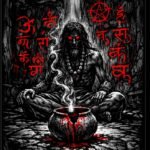
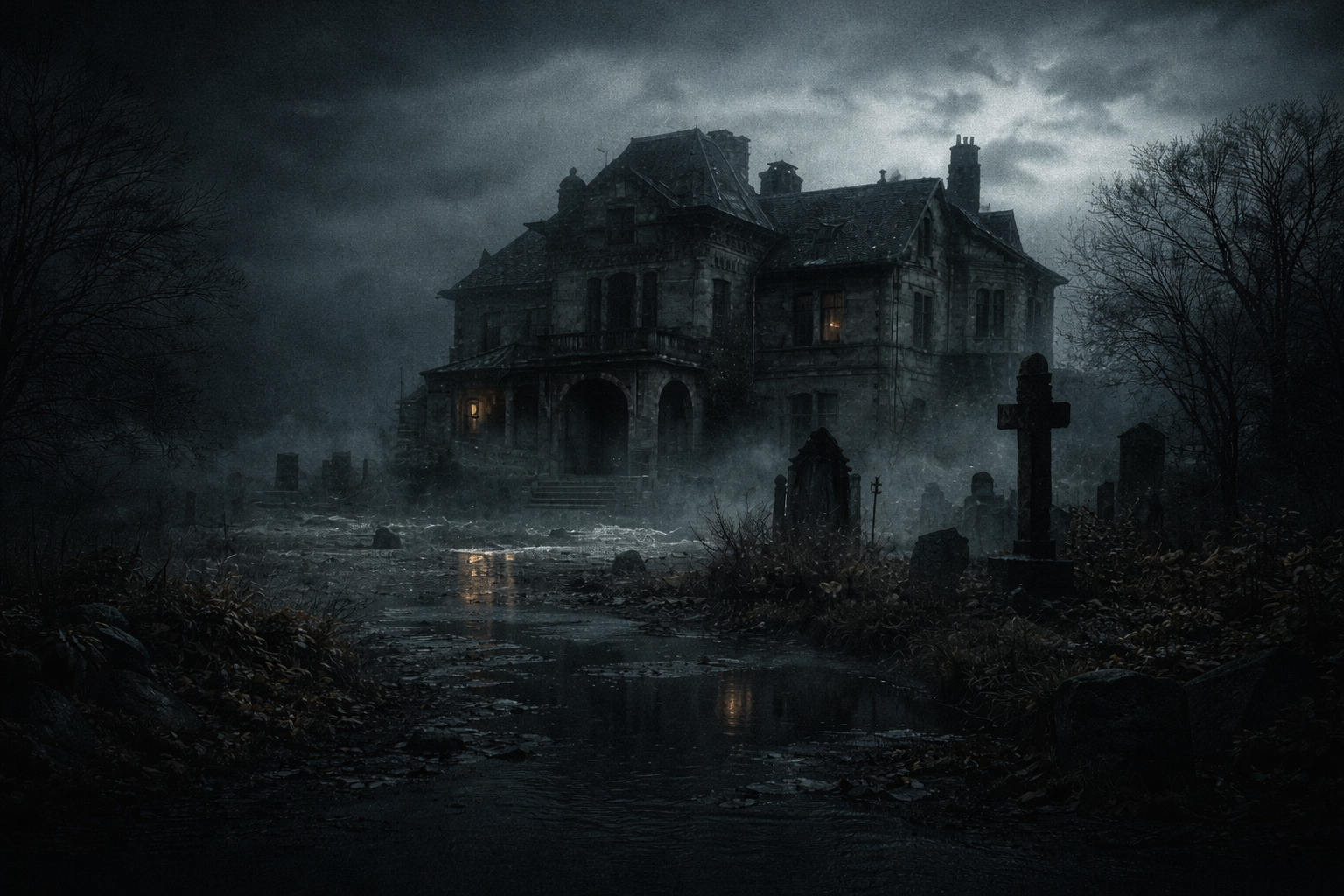
8 Indian Village Horror Stories: Real Tales From the Heart of Bharat That Will Shake You to Your Core
Gaon ki raat sheher se alag hoti hai.
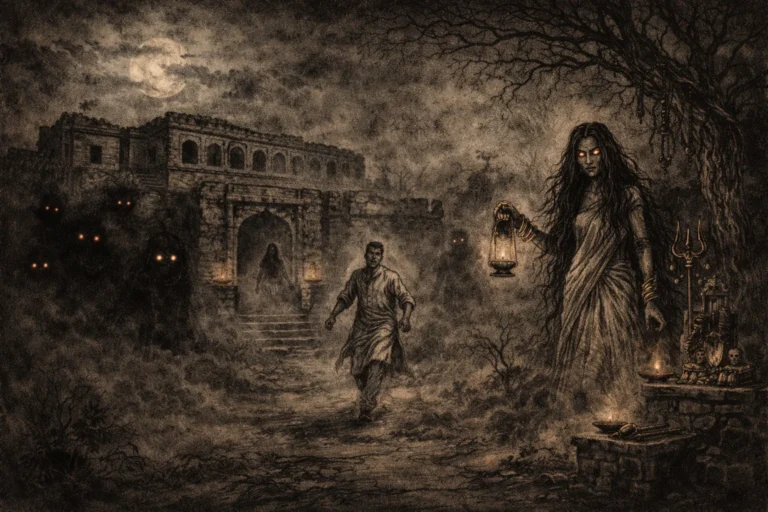
In a city, darkness is just the absence of light. You flip a switch — it ends. But in an Indian village, the dark is something else entirely. It has weight. It has presence. It has memory. The walls of old havelis remember what happened inside them. The peepal tree at the edge of the field has been standing since before your grandfather’s grandfather was born — and it has seen things that no living person has.
Indian village horror stories are not made up around bonfires for entertainment. They are warnings. They are grief. They are the recorded memory of a community that learned, the hard way, what happens when certain rules are broken — when the diya goes unlit, when the old tree is cut, when the woman at the crossroads is ignored.
You have been warned. You are still reading.
Chaliye shuru karte hain.
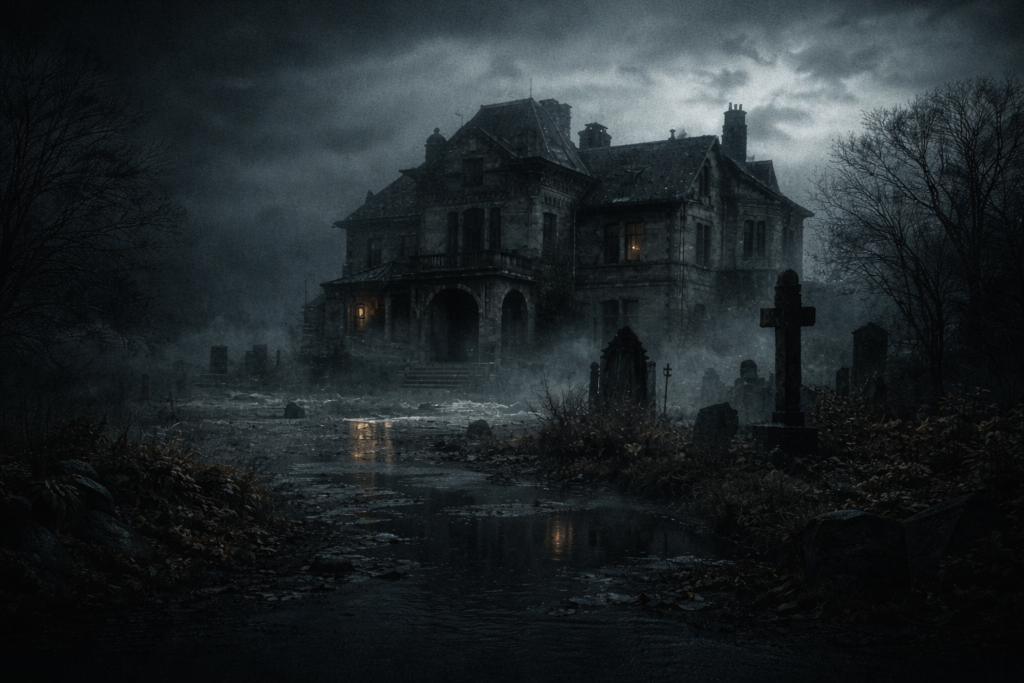
Why Village Horror Hits Differently Than City Ghosts
City ghost stories happen in apartments, in parking lots, in elevators. They are isolated. One person. One encounter. Move out, and it’s over.
Village horror doesn’t work that way.
In a village, the haunting belongs to the land itself — to the well, the tree, the crossroads, the old cremation ground at the field’s edge. You cannot move away from it because the village itself is built on top of it, around it, in a centuries-long negotiation with whatever lives there. The entire community carries the knowledge. It is passed from grandmother to child, from priest to farmer, from the woman drawing water at dawn to the man walking home from the fields at dusk.
This is why Indian village horror stories are, fundamentally, community horror — and why they are far more terrifying than anything a city can produce.
The Chudail at the Crossroads — Every Village in North India
Teen raaste milte hain. Raat ka waqt hai. Aur wahan koi khadi hai.
Every village in North India has one. A crossroads — teewaar or chauraha — where three or four paths meet. And every village elder will tell you the same thing without being asked: do not stop at the crossroads after midnight. Do not eat there. Do not sleep there. Do not look too long at anything you see standing there.
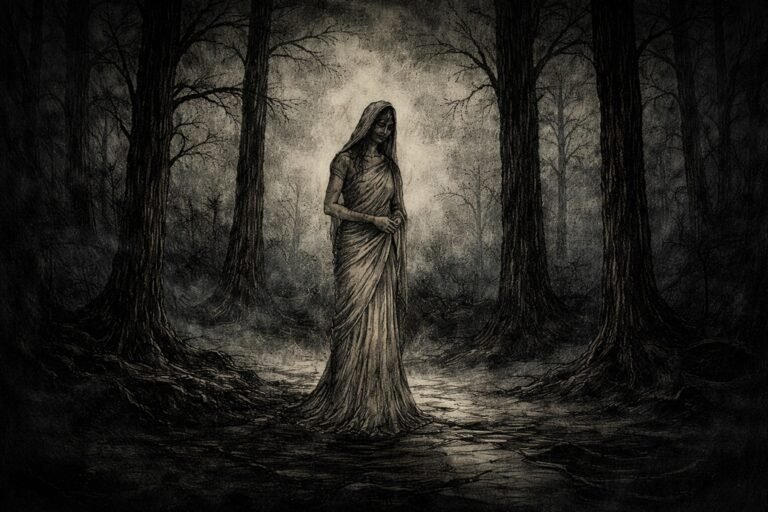
The Chudail — the spirit of a woman who died during childbirth, or as a young bride, or by violence — chooses crossroads as her domain because they are places of transition, of in-between. Not here, not there. The crossroads belongs to no one, which means it belongs to her.
She appears as an ordinary woman. Young. Perhaps even beautiful. She might ask for directions. She might ask for help finding her home. And if you stop — if you engage — you will notice it only when you look at her feet. They point backward. Heels forward, toes behind.
By the time you notice, she has already noticed that you’ve noticed.
In dozens of villages across Uttar Pradesh, Rajasthan, and Madhya Pradesh, families have specific rituals performed after the death of a young woman or a woman in childbirth — precisely to prevent her becoming a Chudail. The rituals are taken extremely seriously. Because the villages that skipped them — the families that said “yeh sab andhvishwas hai” — have stories that their grandchildren still whisper.
Also Read : Rakt Pass Horror Story
Jatinga, Assam — Where the Birds Come to Die
This one does not require belief in ghosts. It requires only your eyes.
Every year, between September and November, in the village of Jatinga in Assam’s Dima Hasao district, something happens that has baffled ornithologists, scientists, and paranormal investigators alike for decades.
At sunset, birds — dozens, sometimes hundreds of them — begin flying toward the village. Not landing. Plunging. Straight down, at full speed, into the ground, into walls, into trees. The birds are not sick. They are not disoriented by any explainable cause. They are flying perfectly normally — and then, upon reaching a specific area of the village, they simply… fall.
Scientists have proposed wind patterns, fog, light refraction. The villagers have a different explanation. They say the land in that area is claimed by something — a presence so strong that birds, who feel things humans have learned to ignore, cannot fly over it without being pulled down.
The truth is: no scientific explanation has fully satisfied the observations. The birds still fall, every year, in the same place, in the same months. The village of Jatinga remains one of the most genuinely unexplained locations in India — because the horror here requires no belief system at all. You can watch it happen with your own eyes.
The Abandoned Haveli and the Odhni That Moves — Rajasthan
In a village outside Barmer, there is a haveli that has been empty for forty years. The family that owned it did not sell it, did not demolish it, did not give it away. They simply left — all at once, in a single night — and never came back.
The village knows why, though they don’t discuss it openly with outsiders.
The patriarch of the family had remarried after his first wife died — too soon, the village felt, without the proper mourning period, without the proper rituals to release her spirit. The second wife began seeing things on the third night of her marriage. An odhni — a woman’s long dupatta — folded on the wedding bed when she returned to the room. She hadn’t left one there. She threw it out the window.
The next morning it was folded on the bed again.
This continued for eleven days. On the twelfth day, the odhni was no longer folded on the bed. It was folded around the second wife’s wrists — tied, not draped — and she was found standing in the center of the courtyard at 3 AM, eyes open, unresponsive, facing the direction of the first wife’s grave.
The family left that night. The odhni is still there, people say — still moving. Local children dare each other to look through the haveli’s broken windows after dark. None of them have looked for long.
The Dayan of Bihar’s Villages — When the Healer Becomes the Hunted
This story is not only supernatural. It is also a story of what fear does to communities — and why some village horror is human horror wearing a supernatural mask.
In dozens of villages across Bihar, Jharkhand, and Chhattisgarh, the accusation of being a Dayan — a witch — has destroyed the lives of women for centuries. Usually older women. Usually widows. Usually women who lived alone, who knew herbal medicine, who had knowledge that the village both needed and feared.
When a child fell sick and didn’t recover. When the cattle began dying. When the harvest failed three seasons running. Someone had to be responsible. And the someone was almost always the woman at the edge of the village who the rest of the community had always found a little too independent, a little too knowing.
But here is where the horror gets layered. Because in many of these same villages, the women accused of being Daayans — the ones who were driven out, beaten, sometimes killed — came back.
Not in person. In the illnesses of their accusers’ children. In the sounds from empty rooms. In the nightmares that settled on the men who had raised their hands.
The Dayan stories of Bihar are terrifying not just as supernatural tales but as a mirror — showing what happens when a community’s fear of the unknown finds a human target. And what happens afterward, when the ghost of injustice refuses to stay buried.
The Thing in the Mustard Field — Punjab at Harvest Time
Harvest season in Punjab. The mustard is gold, the air smells of earth and grain, and the whole village is in the fields from dawn to dusk. This is when the Munja appears.
The Munja is the spirit of a young brahmin boy who died before his sacred thread ceremony — the janeu — could be performed. He is therefore forever suspended between boyhood and manhood, belonging to neither world, recognized by neither the living nor the dead.
He is mischievous at best, dangerous at worst. He moves through fields at night, tangling the grain, hiding tools, leading farmers in circles. He is drawn to young children — particularly boys approaching the age of their own initiation ceremonies — and follows them home.
The families who notice a Munja has attached itself to their child report the same sequence: the child becomes hyperactive then suddenly listless, begins talking to corners, stops eating, and develops an inexplicable fascination with the field where the attachment began.
The ritual to remove a Munja is specific — it must be done by a priest at dawn, before the sun fully rises, at the exact location where the attachment occurred. It must include the completion of a symbolic janeu ceremony, giving the Munja’s spirit what it was denied in life.
Because ultimately, that is what village spirits want more than anything. Not revenge. Not victims. Just — what they were denied.
Dow Hill’s Death Road — Kurseong, West Bengal
There is a road in Dow Hill, Kurseong, that the local timber workers call the Death Road. It runs through a dense forest, and it is a perfectly ordinary-looking road — the kind you’d walk down without a second thought in daylight.
The workers do not use it between December and March. Not for any payment. Not for any reason.
The headless boy has been seen on this road by too many independent witnesses across too many decades for it to be dismissed as shared imagination. He walks from the road toward the forest — purposeful, unhurried, always in the same direction. He never varies his path. He never reacts to being seen. He walks until he reaches the treeline, and then he simply is no longer there.
The Victoria Boys’ School on Dow Hill closes every year for those same three months. During that closure, the caretakers — the only people remaining on the premises — report sounds from the empty corridors. Footsteps. The sound of children playing in rooms that have been locked and empty since the students left.
The school has been closing every year for the same three months for as long as anyone can remember. The caretakers have changed many times. The sounds have not.
The Cursed Well of the Tantric’s Village — Central India
In villages across Madhya Pradesh and parts of Rajasthan, there exists a specific horror tied to kale pani — black water. Wells that have been used in tantric rituals, into which offerings have been made, around which dark sadhanas have been conducted.
The belief is consistent across regions: a well used for dark ritual absorbs the ritual permanently. The water carries it. Whoever drinks from it, whoever draws from it without proper precaution, begins to carry something home with them — something that settles into the house’s corners, that watches the family from the space just above the ceiling beams.
One story from a village outside Sagar, MP: a new family moved into a home with an old well in the courtyard. The previous family had left in a hurry — their belongings still partially stacked against the walls. The new family began having the same dream within a week of moving in. All of them. The same dream: standing at the edge of the well, looking down, and seeing not their own reflection but a pair of hands reaching up from the water below, grasping at nothing.
The dream stopped the day they sealed the well with concrete and placed a tulsi plant above it.
The hands in the water — no one saw them again.
Kuldhara’s Last Night — Rajasthan’s Ghost Village
Near Jaisalmer, the ruins of Kuldhara stand in the desert like a memory that refuses to dissolve.
In the early 19th century, all 1,500 residents of this prosperous Paliwal Brahmin village vanished in a single night. Not just disappeared — they performed a ritual departure, calling a formal curse on the land before they left. They declared that no one would ever settle in Kuldhara in peace. That the land would reject every attempt at permanent habitation.
The curse has held. Every family that has tried to settle in the ruins across nearly two centuries has left — driven out by sounds, by visions, by an inexplicable sickness that lifts the moment they cross the village boundary. The ASI has preserved it as a heritage site, and security guards are posted but do not stay past dark.
Paranormal investigators from across India have documented audio recordings at Kuldhara — voices in empty rooms speaking in an outdated dialect of Marwari, the language the Paliwal Brahmins spoke. Photography equipment malfunctions specifically within the ruins, while working normally the moment it is carried outside.
The desert wind moves through Kuldhara differently than it moves anywhere else nearby. Softer. Slower. Like something is listening.
The Pret at the Mango Grove — A Story That Belongs to Every Village
Every village in India has a mango grove that someone remembers differently than the rest. Not haunted in a dramatic way — no sounds, no visions, no strange lights. Just — wrong. A mango grove where the fruit is always plentiful but no one picks it after dark. Where the shade is deep and welcome in summer but no one sleeps under it. Where the oldest tree, the one whose trunk is so wide two men cannot wrap their arms around it, has a small stone at its base that is always fresh-garlanded, always has a diya burning beside it.
The stone is for the Pret — the spirit of the man or woman who died suddenly, violently, without proper rites, and whose soul attached itself to the spot.
The Pret does not ask for much. The diya. The garland. The acknowledgment that something happened here, that a life ended here, that this soul existed and mattered.
Villages that maintain this acknowledgment — that keep the diya burning, that teach their children why that stone is garlanded — live in a kind of negotiated peace with what rests in the grove. The mango tree provides. The stone is respected. The old agreement holds.
Villages where the new generation mocks the stone, where the diya goes unlit for a season, where someone in a hurry kicks the garland aside — those villages begin to have a bad year. Then another. Then someone in the family falls ill in a way that the doctor finds puzzling.
Then someone goes back to the grove and reights the diya. And slowly, carefully, the agreement is reinstated.
It is a horror story. It is also a love story, of a kind. A negotiation between the living and the dead that has kept rural India functioning across thousands of years — a constant, quiet reminder that we live on top of history, and history is not always at rest.
Why These Stories Will Never Die
India has 600,000 villages. Each one has its own particular darkness, its own specific unquiet dead, its own negotiated boundaries between the world of the living and whatever lies just past the visible.
The digital age has not dimmed these stories — if anything, it has amplified them. Hindi horror podcasts have millions of listeners. YouTube channels dedicated to village horror stories are growing faster than almost any other content genre in India. Because underneath the urbanization, underneath the smartphones and the delivery apps and the concrete, the village is still in us. The village is where we came from — barely two or three generations back for most Indian families.
And the village remembers.
Apne gaon ka naam lena. Wahan jo purana ped hai — kya uske neeche diya jal raha hai aaj raat?
Say the name of your village. The old tree at its edge — is the diya still burning there tonight?
Agar nahi — toh aaj raat jalana.
If not — light one tonight.
Just to be safe.
Frequently Asked Questions
Q: Are Indian village horror stories based on real events?
Many are rooted in documented historical events, regional customs, and eyewitness accounts passed down through generations. Cases like Kuldhara’s mass departure and Jatinga’s bird deaths have been investigated by scientists and historians.
Q: Which is the most haunted village in India?
Kuldhara in Rajasthan is the most widely recognized haunted village in India, with documented paranormal activity and an official heritage status. Bemni in Uttarakhand and Dow Hill in West Bengal are also among the most reported.
Q: What is the most common type of ghost in Indian village folklore?
The Pret — a spirit formed from sudden or violent death without proper last rites — is the most widespread supernatural entity across Indian village traditions, appearing in virtually every region’s folklore.
Q: Why are Indian village horror stories so popular in 2026?
The genre has exploded digitally — with horror podcasts, YouTube channels, and Instagram horror accounts reaching millions of Indians who grew up with these stories and now consume them through screens. The cultural authenticity of village-based horror resonates deeply across generations.