Rakt Paas — The Tantric Who Opened a Door That Could Never Be Closed
Gujarat, somewhere in the barren Rann borderlands. Year unknown. Some stories refuse to be dated.
Prologue: The Village That Smelled of Ash
The first sign that something was wrong in the village of Kharavdi was the smell.
Not the smell of a fire. Not wood smoke or burning crops. This was different — dry, ancient, like something buried deep in the earth had been heated from below. The kind of smell that makes your nostrils flare and your stomach drop before your mind has even figured out why.
The farmers noticed it first. Then the women drawing water from the well. Then the children stopped playing after sundown — not because their mothers called them inside, but because they simply didn’t want to be outside anymore. Children know things before adults do. They feel the shift before it becomes visible.
The shift had a name.
Rakt Paas.
Part One: The Man Who Came From Nowhere
No one in Kharavdi could clearly remember when Rakt Paas arrived.
That, in itself, was the first strange thing. In a village where everyone knows everyone — where a stranger’s footstep on the main path is visible from a dozen doorways — somehow, this man had simply appeared. As if the desert had opened and placed him there between one breath and the next.
He was thin. Not the thinness of poverty or illness, but something deliberate — like a man who had chosen to reduce himself, to make himself smaller than his bones, to strip away everything that was not purely intent. His eyes were the color of dried blood. Not red — nothing so dramatic. Just that specific dark brownish-red that you see on stone walls where something has dried and been forgotten.
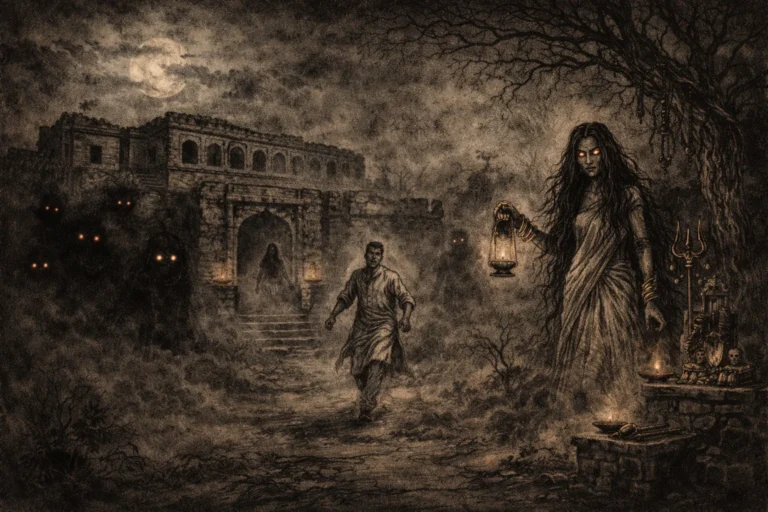
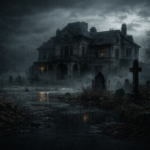
He took up residence in the abandoned Bhatiyara house at the edge of the village — the house where three generations of the Bhatiyara family had died in a single monsoon season fifteen years earlier. Nobody had lived there since. The walls still had their handprints. The tulsi plant in the courtyard had kept growing, untended, alone, as if it were waiting for someone.
Rakt Paas arrived. The tulsi plant died overnight.
Part Two: What the Babra Bhoot Sadhana Is
You need to understand what he was attempting. Because without understanding the ritual, you cannot understand the horror of what happened next.
The Babra Bhoot Sadhana is one of the most forbidden practices in the left-hand path of Indian tantra — so dangerous that even serious tantric practitioners refuse to speak its name above a whisper. The word Babra means “wild” or “untamed.” The word Bhoot you already know. A Sadhana is a spiritual practice — a discipline of the self in pursuit of power.
But this particular Sadhana is not a path toward power. It is a negotiation with something that has no interest in being reasonable.
The ritual requires:
- Complete isolation — no human contact from the first night of the new moon until its completion
- Continuous chanting without a single break, not even for sleep, for seven consecutive nights
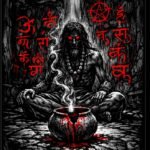
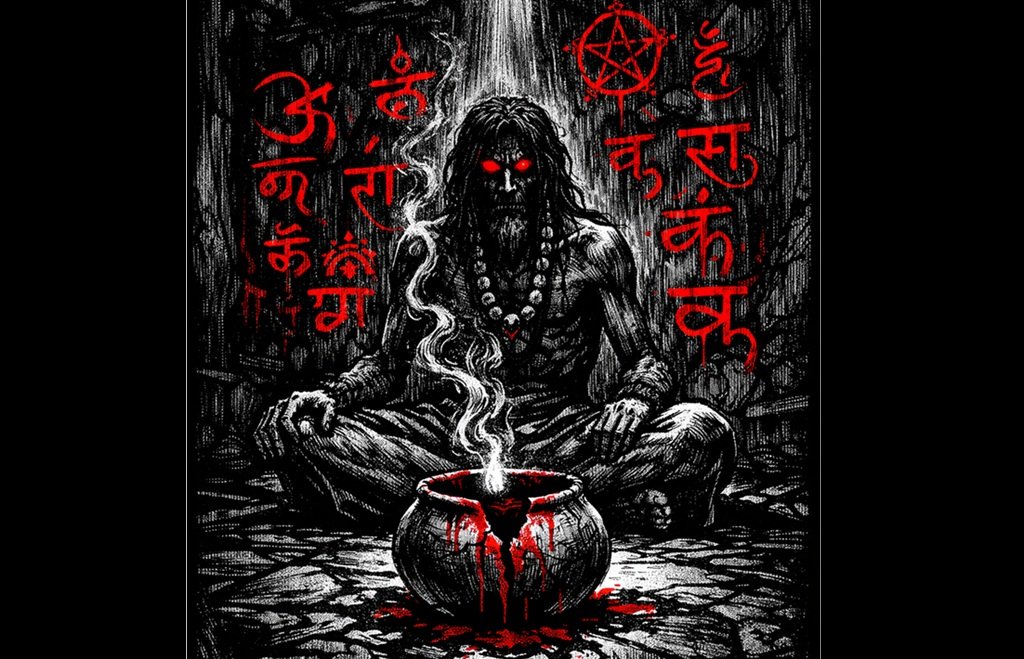
- An offering of blood — the practitioner’s own — poured into a clay vessel that must be kept warm throughout
- And the invocation — spoken in a precise sequence of syllables so unstable that a single error, a single mispronounced vowel, causes the summoned entity to turn not outward, but inward — consuming the practitioner from within
What is being summoned is not a ghost in the traditional sense. A Babra Bhoot is a spirit that has been denied death — a consciousness trapped between worlds by extreme violence or injustice, and driven completely, irreparably mad by the in-between. It is rage without shape. Hunger without body. Pain without end.
And Rakt Paas wanted to control one.
Part Three: Seven Nights
The village noticed the chanting on the second night.
It was faint at first — low, rhythmic, the kind of sound that you aren’t sure you’re actually hearing. Like a frequency at the edge of audible range. Mohan, the village potter who lived closest to the Bhatiyara house, described it to his wife as “a stone humming.” She told him he was dreaming. He was not dreaming. He didn’t sleep again for the rest of the week.
By the third night, the sound had changed. It had deepened. And it had begun to carry something inside it — an undertone that wasn’t quite musical, wasn’t quite language, but sat in your chest like a fist and made your heartbeat irregular.
The animals knew by the fourth night. Every dog in Kharavdi fell silent. Not the silence of sleep — the silence of animals that are standing completely still, ears pinned, eyes fixed in one direction, waiting. The buffalo stopped eating. Three goats were found dead the next morning with no visible cause — no injury, no illness, no explanation. Their eyes were open. Looking at nothing. Or perhaps looking at something no living creature should see.
By the fifth night, people started seeing things.
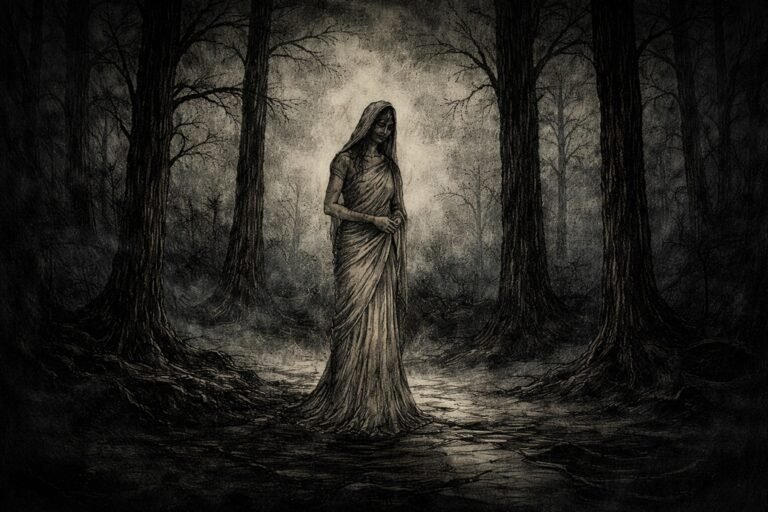
Ratan Singh, a farmer in his fifties who had never believed in anything he couldn’t touch, saw a woman standing in his fields at 2 AM. Just standing. Still as a post. He called out to her. She turned, and in the moonlight, he saw that her face was — wrong. Not monstrous. Not disfigured. Just wrong, the way a reflection in rippled water is wrong — almost right, almost familiar, but off in a way that makes your entire body recoil before you can name why.
He ran inside. He did not go back to his fields for eleven days.
Part Four: The Sixth Night — When It Escaped
This is the part the elders tell in the lowest voices.
On the sixth night, something changed in the chanting. The rhythm faltered. Not stopped — faltered. A single break in the cadence, perhaps half a second, perhaps less. A stumble in the syllable sequence.
That was all it took.
Those awake in Kharavdi that night described what followed as a silence so total it was louder than sound. The chanting stopped. And in its absence, there was something else — a pressure, a presence, something that moved through the village like a wave of cold water on a summer night, passing through walls, through closed doors, through the spaces between sleeping bodies.
The Babra Bhoot was free.
Not controlled. Not bound. Not pointed in any direction like a weapon the way Rakt Paas had intended. Just — free. Wild. Untamed. Exactly what its name promised.
What happened next unfolded over three weeks.
A child in the village began speaking in a voice not her own — complete sentences in a dialect no one in the region recognized. She spoke for six hours straight, then collapsed and remembered nothing. The village vaid could find nothing wrong with her.
The eldest member of the Chauhan family — a man of eighty-two who had survived partition, drought, and the death of four children — woke up one morning unable to recognize his own wife of sixty years. He looked at her as if she were a stranger. This continued for ten days. Then, one morning, he simply didn’t wake up. His face, the family said, looked like a man who had seen something during the night so terrible that dying was the preferable response.
Two young men from the village went to investigate the Bhatiyara house on a dare. They walked in together. Only one walked out. The other was found the next morning, sitting in the corner of the innermost room, knees pulled to his chest, rocking. He never spoke again. He lived for twelve more years in that state — rocking, silent, eyes focused on something just past the visible world.
Part Five: What Was Found in the Bhatiyara House
When the village panchayat finally gathered enough courage to send people into the Bhatiyara house — armed with burning camphor, red thread, and a priest from the next village — what they found was this:
Rakt Paas was gone.
The room where he had conducted the Sadhana was completely undisturbed except for one thing: in the center of the floor, the clay vessel that had held his blood offering was cracked open. Whatever had been inside had dried. The crack ran from rim to base — perfectly clean, as if it had been split from within by something expanding outward.
On the wall, in something that was not paint, were markings. The priest recognized some of them as corrupted tantric syllables — the kind used in the final stage of an invocation gone wrong. He covered them with white cloth immediately and began his own counter-rituals.
But there was one more thing. In the center of the cracked vessel, placed deliberately, was a single item: Rakt Paas’s own tooth. Pulled, not fallen. Placed there intentionally, as if in payment.
Payment to what, for what — no one ever determined.
Epilogue: Kharavdi Today
The village of Kharavdi still exists. The Bhatiyara house was torn down in the late 1990s, and a small shrine was built on its foundation — a neem tree planted at its center, wrapped in sacred red thread that the women of the village replace every Amavasya.
The smell of ash returns sometimes. Usually in the dry months, usually late at night, usually when the wind stops completely and the desert goes utterly, absolutely silent.
The older residents don’t talk about Rakt Paas by name.
“Kuch cheezein naam lene se jaag jaati hain,” an old woman from the village once said.
Some things wake up when you speak their name.
What the Story of Rakt Paas Actually Teaches
Strip away the horror — and this story is about the arrogance of control. Rakt Paas did not stumble upon dark power by accident. He sought it, deliberately, systematically, with the absolute certainty that his preparation was sufficient to contain what he was calling forward.
It wasn’t.
The Babra Bhoot Sadhana is feared in Indian tantric tradition not because the entity it invokes is the most powerful — there are darker invocations. It is feared because of what it demands of the practitioner: perfection. Total, unbroken, inhuman perfection across seven full nights. And the tragedy of Rakt Paas is the tragedy of every person who believed that their will was stronger than their limits.
Kuch darwaze isliye band hain — kyunki andar jo hai, woh bahar nahi aana chahiye.
Some doors are kept shut not to keep people out. But to keep what is inside — in.