There’s a particular kind of fear that only old folklore can produce — not jump-scare fear, but the slow, creeping kind that settles into your bones when you’re walking home alone at night and you hear the faint sound of anklets jingling behind you.
No one is there when you turn around.

That’s the Churel.
If you’ve grown up in North India — or anywhere in South Asia, really — you’ve heard her name whispered. Maybe it was your dadi who warned you never to walk near the old peepal tree after dark. Maybe it was a neighbor who swore they heard her laugh near the village well. The Churel isn’t just a ghost story. She’s woven into the walls of our culture, into how we understand grief, injustice, and the things that women were never supposed to say out loud.
Let me take you deep into her story.
Who Is the Churel?
The Churel — also written as Churail, Chudail, or Jakhin depending on the region — is one of South Asia’s oldest and most feared supernatural beings. She is the spirit of a woman who died under deeply unjust or tragic circumstances: during childbirth, during pregnancy, or in the prescribed “period of impurity” — a time when traditional belief held a woman to be ritually unclean.
But it isn’t just how she died. It’s why she came back.
The Churel returns because she was wronged. Neglected by her family. Mistreated by her husband. Left to die without dignity. Her unfinished grief, her unspoken rage — that becomes the fuel of her haunting.
She isn’t a mindless monster. She’s a mirror. And the reflection she shows is uncomfortable.
What Does She Look Like?
This is where it gets interesting — and slightly terrifying.
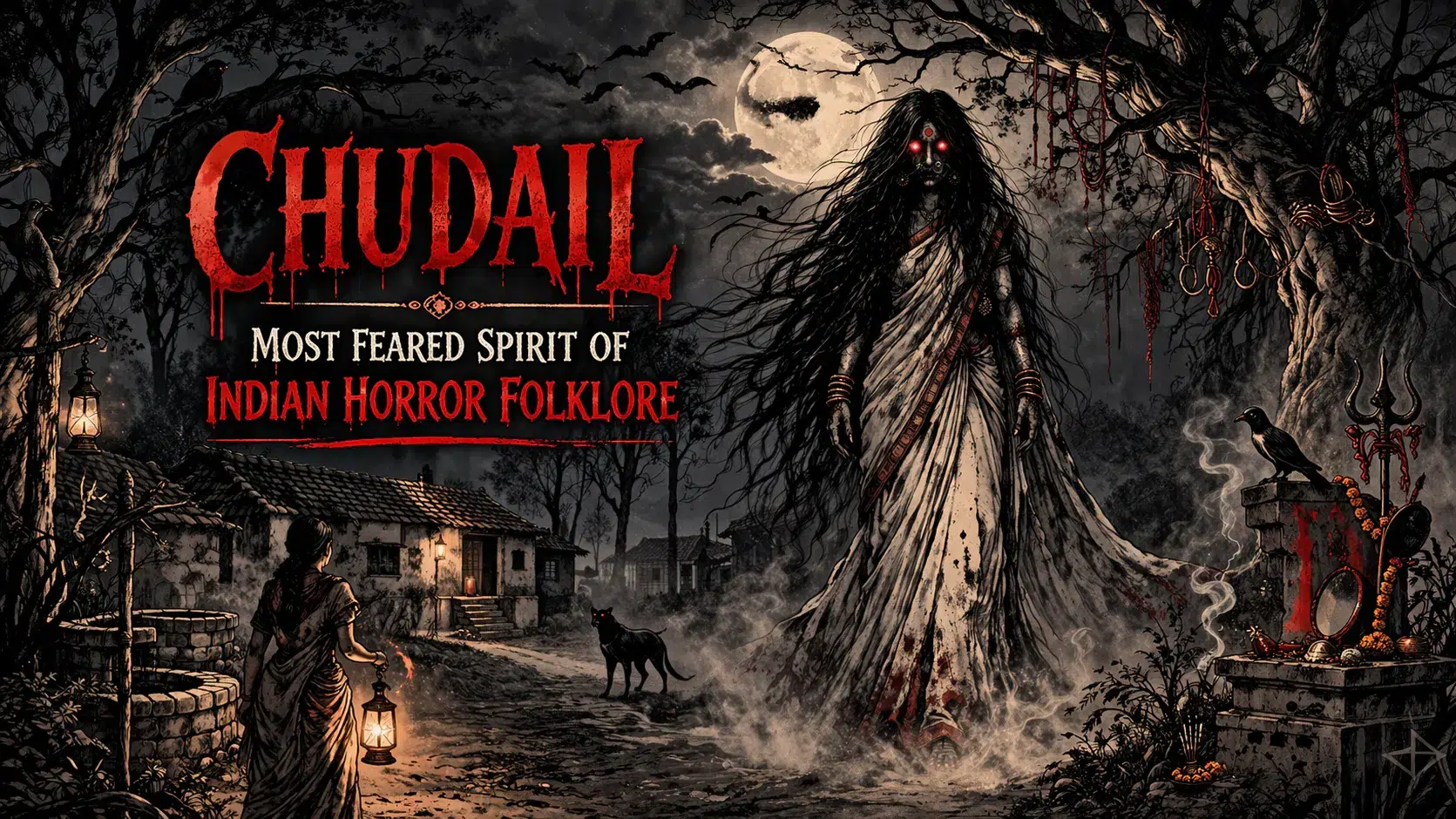
Unlike most horror movie monsters, the Churel is a master of disguise. She doesn’t always appear grotesque. In fact, many accounts describe her as strikingly beautiful, dressed in white, fragrant as jasmine, appearing at crossroads or under large trees at night.
Her tell? Look at her feet.
The Churel’s feet are said to be turned backward — heels in front, toes behind. This is her one flaw she cannot hide. Some versions also say her skin is slightly off-color in moonlight, or that her shadow doesn’t fall the right way.
In her more terrifying form — when she stops performing — she is described as:
- Wild, matted hair
- Dark, emaciated body
- Long, blackened tongue
- Hollow, sunken eyes
She is both the beautiful woman and the nightmare beneath. That duality is exactly what makes the Churel so psychologically haunting even today.
How She Hunts
The Churel doesn’t stalk randomly. She has a preference: men — particularly young ones from the family that wronged her, or men who wander alone at night near places associated with death and isolation.
Her method is seduction.
A traveler hears soft laughter in the dark. A faint smell of flowers where there should be none. A woman in white who appears at the edge of a forest path, her face half-hidden. She beckons, and if the man follows —
He is never quite right again.
Accounts across Rajasthan, UP, Bihar, and Punjab describe men returning from such encounters aged beyond their years: hollow-eyed, life-drained, unable to explain where they went or how long they were gone. The Churel doesn’t just take your life — she takes your years, your vitality, leaving the husk of a person behind.
In the most extreme accounts, the man doesn’t return at all.
Regional Flavors of the Churel
What’s fascinating about Indian folklore is that it refuses to stay still. Every region adds its own texture to a story, and the Churel is no exception.
Rajasthan:
The desert state has its own grim variations. Near cremation grounds and dry riverbeds, locals speak of female spirits tied to places where women died in abandonment. The arid landscape — isolated, vast, moon-washed at night — seems made for her. Villages near old havelis sometimes still perform protective rituals during the last days of pregnancy to ensure a death in childbirth doesn’t create a new restless spirit.
Punjab:
Perhaps the most elaborate protective rituals come from Punjab. If a woman died under suspicious circumstances, the body was buried with iron nails at all four corners of the grave. In extreme cases, the hands and feet of the corpse were nailed down and chains placed around the ankles — not to dishonor the dead, but out of genuine, bone-deep fear of what she might become.
Bengal:
In Bengal, women who died during childbirth were buried with thorns and stones placed around their graves to prevent the spirit from rising. The Bengali version often appears near wells — a watery, dark presence rather than the desert wanderer of the North.
Maharashtra:
Here, the spirit overlaps with the Munjya and other tree-bound ghosts — peepal trees at crossroads being the primary haunting ground.
Same terror. Different geography. Different wounds.
The Social Truth Inside the Horror
This is the part that most horror blogs skip over, and honestly, it’s the most important part.
The Churel legend didn’t come from nowhere. She emerged from a very specific social reality: a world where women’s deaths — especially during childbirth or at the hands of negligent families — were common, under-investigated, and quickly forgotten.
The Churel is the community’s way of keeping that guilt alive.
Her legend essentially says: if you mistreat a woman and she dies because of you, she will come back. Not helpless this time. Not silenced. Vengeful.
That’s not just horror. That’s accountability wrapped in folklore.
In a society where women had little legal recourse, the Churel was a supernatural court of last resort. Men who mistreated their wives or daughters-in-law lived with the very real fear that death wouldn’t end the reckoning — it would only change its form.
That’s why the legend has persisted for centuries while countless other supernatural figures have faded. She has a reason to exist.
Protection Against the Churel
For those who believed, protection was serious business.
- Iron nails driven into the four corners of a suspected Churel’s grave to pin the spirit down
- Red flowers planted over the burial site as both offering and ward
- Mustard seeds scattered around the home — the Churel supposedly must count every seed before entering, and loses track repeatedly until dawn
- Prayers and offerings made at the place she died, acknowledging her grief and asking for peace
- Never responding to your name called from outside the house at night — a calling voice that sounds like a loved one may be the Churel luring you out
The last one still gives me chills, personally. Because there’s something deeply rational about it: don’t trust voices in the dark.
Why the Churel Still Haunts Us
It would be easy to dismiss all this as old village superstition — stories told by firelight to frighten children and keep people indoors after dark.
But look around.
The Churel appears in modern Indian horror films regularly. She shows up in web series, Instagram reels, late-night YouTube narrations. She’s been reimagined in contemporary fiction and graphic storytelling. She refuses to leave.
Because the conditions that created her — women dying in neglect, their pain unacknowledged, their stories untold — those haven’t fully disappeared either.
Every generation rediscovers the Churel because every generation has its own version of the same grief.
A Story Worth Sitting With
There’s a tale from the Punjab hills — no specific village, the way the best folklore never has a specific village — about a young bride who died three days after her wedding. Her in-laws had treated her poorly from the moment she arrived; small cruelties, unspoken contempt, a general sense that she was a burden.
She was buried quickly.
Within a month, the men of the household began to look older. First the husband. Then the brothers. The father-in-law woke one morning with white hair he hadn’t had the night before. A neighbor, visiting late one evening, claimed he saw a woman in white standing at the edge of the courtyard, feet pointing backward, watching the house in silence.
They finally called a pandit. He performed the rites, made the offerings, acknowledged what had been done.
The appearances stopped.
The men never fully recovered.
The Churel isn’t just horror. She’s history, psychology, and folklore all folded into one terrifying figure. She is what happens when grief has nowhere to go. When injustice goes unanswered long enough, it finds its own form.
The anklet sound in the dark. The smell of jasmine where there are no flowers. The woman at the crossroads whose feet you should really check before you follow her anywhere.
She’s been waiting a long time.
She can wait a little longer.
Enjoyed this? The Churel is just one of hundreds of forgotten figures in India’s vast horror folklore. Every state, every district, every village has its own shadows. We’re just getting started.