
The Nishi Dak: Bengal’s Most Deadly Voice in the Dark
It is 2 AM.
The village outside Kolkata is silent in that specific way only rural Bengal can be — no traffic, no voices, just the low chorus of crickets and the occasional rustle of banana leaves. You are lying on your side, half-pulled into sleep, when you hear it.
Your mother’s voice. From outside the window.
Soft. Familiar. The exact warmth of her calling you for dinner, calling you home from play as a child. Your name, shaped perfectly in her mouth, the way only she has ever said it.
Your body is halfway out of the bed before your brain catches up.
And then you remember: she is right there. Sleeping. Her breathing slow and steady, three feet away from you.
You freeze.
The voice calls again. Patient. Waiting.
That’s the Nishi Dak. And if you had answered — if you had said “coming” or even made a sound of acknowledgment — the stories say you would not have seen morning.
What Is the Nishi Dak?
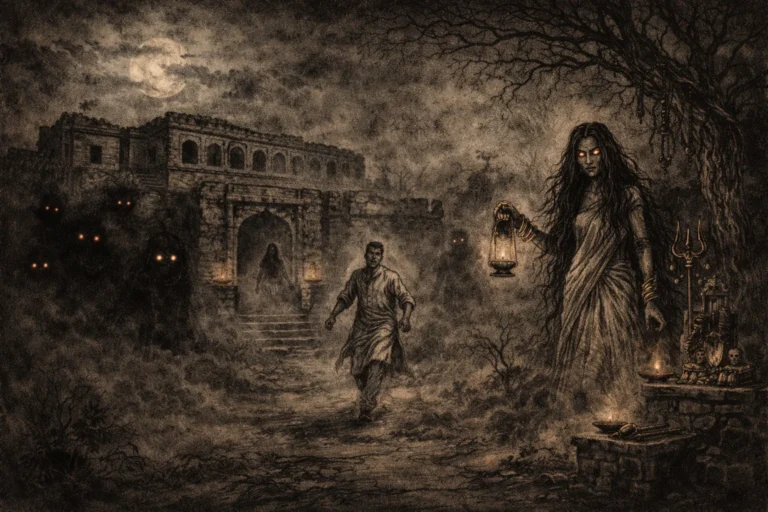
The Nishi Dak — literally translated as the “Call of the Night” — is one of the oldest and most deeply embedded supernatural beliefs in Bengali culture. Unlike most folkloric monsters that have a fixed form — claws, fangs, a describable body — the Nishi is defined almost entirely by sound.
It is a disembodied entity of the night that hunts through voice.
The Nishi identifies its target, learns the voice of the person that target loves most — a mother, a father, a spouse, a child — and then mimics it with terrifying precision. It calls the person’s name. Always at night. Always from just outside: outside the door, outside the window, from the direction of the courtyard or the lane just beyond the gate.
It calls exactly twice.
If you answer on the first call, or walk out on the second, the Nishi has you.
What happens next varies by the telling. Some accounts say the person is found dead before dawn — no marks, no sign of struggle, just gone from the world as if their soul was simply switched off. Others say the person wanders off and is never found at all. A few darker versions describe the victim encountering the Nishi’s true form in the dark: something wrong, something that should not exist, and the sight alone is enough to stop a heart.
The One Rule That Keeps You Alive
Bengali households, especially in older generations and in rural areas, have a rule that is passed down with the seriousness of a commandment:
Never respond to your name being called at night unless you can physically see who is calling.
Not a shout back. Not a “who’s there?”. Absolute silence.
If someone in the family comes home late, they don’t call out names — they knock. If you hear your name from outside after dark, you don’t open the door, you go to the window and look first. You confirm with your eyes before your voice commits you to anything.
This isn’t superstition performed at a festival once a year. This is lived behavior. Grandmothers enforce it. Parents teach it before children even know why. In many Bengali homes, the rule predates every living person in the house — it was inherited, and it will be passed on.
That consistency — that unbroken chain of behavioral warning across centuries — is what separates the Nishi from most other folklore. Most ghost stories are told about things. The Nishi Dak comes with instructions.
Why This Legend Cuts So Deep
Think about what the Nishi specifically weaponizes.
Not darkness. Not isolation. Not the unknown.
Love.
It takes the exact voice of the person you would instinctively respond to without thinking. Your mother’s voice doesn’t trigger caution — it triggers comfort, safety, the deep animal reflex to move toward the person who has always meant home. The Nishi finds that precise frequency and broadcasts it directly into your chest at 2 AM when your defenses are lowest.
That is psychological horror of the highest order.
It understands you. It has done its homework on you personally. The entity that comes for you doesn’t come with claws — it comes knowing your mother’s exact inflection when she says your name, the specific softness in her voice when she’s worried about you. It has watched you, maybe for a long time, and it knows exactly which voice would make you move without thinking.
This is why the Nishi inspires a different quality of fear than, say, a haunted house or a shape in the shadows. It makes you distrust your most trusted thing: the voices of people you love. Once you’ve heard this legend properly, you will hesitate — just a half-second — even when your actual mother calls your name from the next room at night. That hesitation is the Nishi’s fingerprint on your mind. Permanent. Rent-free.
The Regional World It Comes From
Bengal’s landscape is inseparable from its supernatural tradition.
The geography does something to the imagination here — the rivers that shift their paths overnight, the wetlands and mangroves that swallow light, the long monsoon nights where mist sits so thick over the paddy fields that sounds carry strangely, seeming to come from directions that don’t make sense. Sound behaves differently in this landscape. A voice can drift across water and arrive sounding like it’s right outside your door when the speaker is two fields away.
In this environment, a legend built entirely around disembodied voice makes complete sensory sense. People in riverside villages, in the delta marshlands of the Sundarbans, in the fog-wrapped districts of North Bengal — they all live in a world where hearing something you cannot see is completely normal. The Nishi Dak is born from this reality.
It is also worth noting that Bengali folklore is unusually rich and sophisticated in its supernatural tradition — from the Petni and Shakchunni (female spirits with very specific social contexts) to the Brahmadaitya (ghost of a Brahmin, considered particularly powerful) to the terrifying Kanabhulo that causes travelers to lose their path in familiar places. The Nishi exists in a fully developed supernatural ecology. It is not a standalone boogeyman — it is part of a whole worldview about the dangerous, uncanny nature of the night.
The Social Reading: What the Legend Is Really Saying
Strip away the supernatural, and the Nishi Dak carries a sharp practical message that would have been especially vital in rural Bengal centuries ago:
Do not go outside alone at night. Under any circumstances. Not even for someone you love.
Night in a pre-electricity village — or even in a semi-rural area today — carries real dangers. Rivers, unlit wells, wild animals near forest edges, people with bad intentions. A person half-asleep, responding on instinct to a familiar voice, walking outside without a lamp — that person could easily not come back.
The Nishi is folklore’s way of making “don’t go outside at night no matter what you hear” an unbreakable rule rather than a suggestion. Because if the reason is just “it’s dangerous,” a worried child will still run outside when they hear their mother’s voice. But if the reason is “that voice might not be your mother, and answering it might kill you” — suddenly the instinct to stay put is stronger.
This is ancient community wisdom in horror’s clothing. The most effective safety rule in history, delivered as a story instead of a lecture.
Variations and the Third Call
One of the most chilling details found in specific tellings across different districts of Bengal is the question of a third call.
Most accounts are clear: the Nishi calls twice. If it does not get a response, it moves on. The night passes. You are safe.
But some versions — told in hushed voices, the kind where the storyteller looks over their shoulder first — mention that in rare cases, if the entity is particularly hungry, or particularly fixated, it calls a third time.
What does the third call mean? Accounts differ. Some say the third call means the Nishi is desperate and weakening — that if you survive it, the danger passes forever. Others say the third call is the worst sign of all: it means the Nishi has decided you specifically, and it will return the following night. And the night after.
Always twice, each time.
Until you answer.
A Story From the Old Part of the City
A family in a North Kolkata neighborhood — one of those narrow-lane areas where the houses lean toward each other overhead and the streets go quiet by midnight — tells this account, passed down from a great-grandmother.
Her husband had come home late from work, delayed by the trams. She was awake, restless. Around 2 AM she heard her son — twelve years old, sleeping in the next room — called by name. The voice was hers. Her own voice. Asking him to come outside, saying she needed help with something at the gate.
She was sitting four feet from his bed.
She heard the boy stir. She crossed the room in two steps and put her hand over his mouth before he could make a sound. She held him still. She did not speak. She did not go to the window. She sat with her hand over her child’s mouth until the voice stopped, until the night went properly quiet again, and then she held him until morning.
He grew up. He grew old. He told the story to his children and made them learn the rule before they learned their multiplication tables.
You do not answer. Whatever it sounds like. You do not answer.
Why the Nishi Still Matters
In a world of smartphones and streetlights, it would be easy to say the Nishi Dak belongs to another time.
But then you are in a half-sleep at 2 AM in your apartment, and something — some trick of sound, a noise from the street, a neighbor’s voice shaped strangely by the walls — says your name. And for just a moment, you feel it: that old reflex to respond, and the other thing, older still, that says wait.
That pause is the Nishi’s legacy.
It doesn’t matter whether you believe in disembodied night-spirits. What matters is that somewhere in the accumulated wisdom of every Bengali household that has kept this story alive, across every generation that passed the rule down before passing anything else — there is the understanding that the night asks things of us that we should not give.
That some voices, no matter how beloved they sound, need to be seen before they are trusted.
That love, weaponized, is the most dangerous thing in the dark.
The Nishi knows your mother’s voice.
Don’t let it know yours.
Bengal’s folklore is one of the richest, most layered supernatural traditions in the world — and the Nishi Dak is just the beginning. Every story carries something real inside it, if you know where to look.