
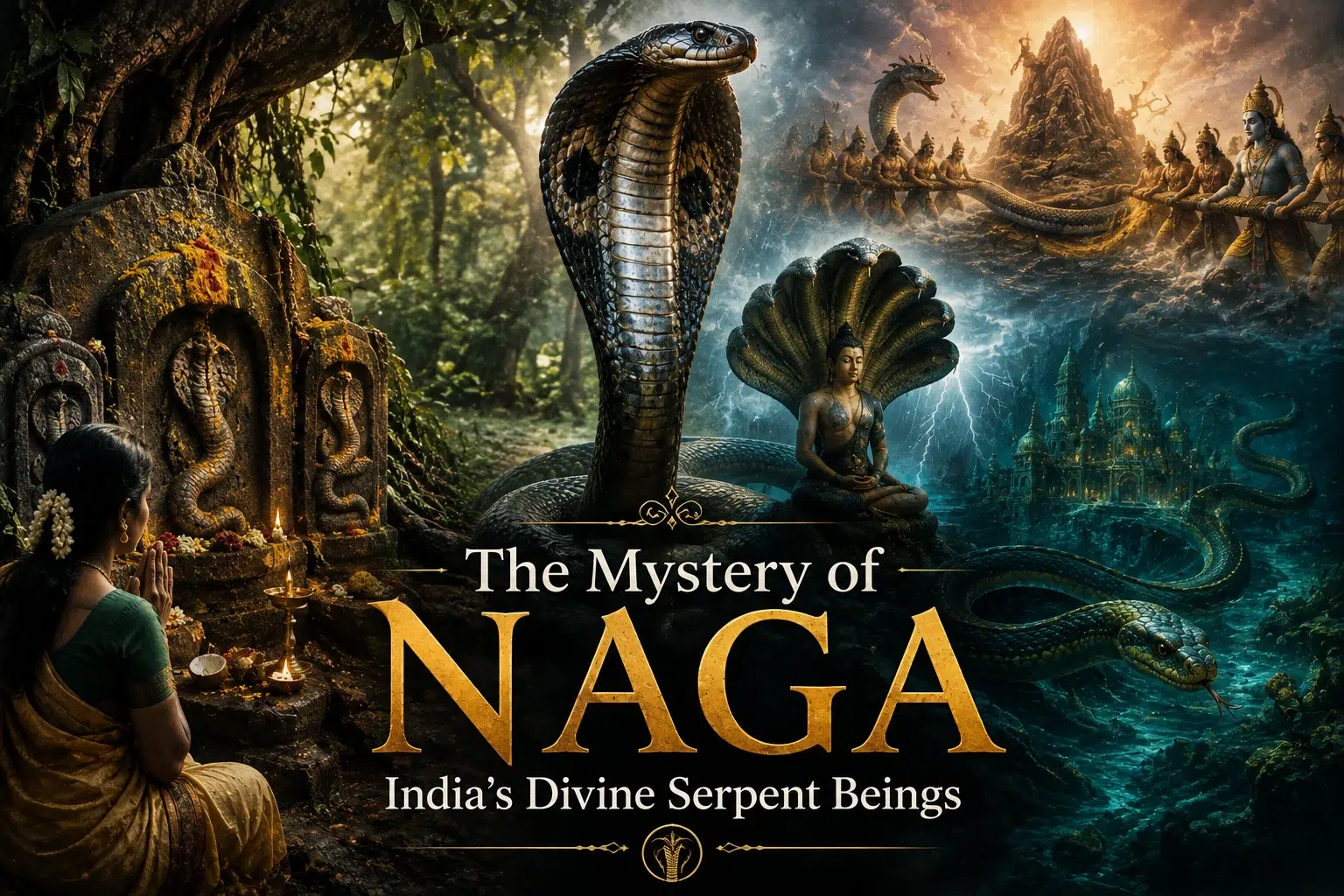
I still remember the first time I walked into a Naga shrine in rural Karnataka. It wasn’t a grand temple — just a cluster of stone serpent figures tucked under an ancient peepal tree, draped in turmeric-stained cloth, surrounded by broken coconut shells and fresh flowers. A woman was kneeling in front of it, eyes closed, lips moving. Whatever she was asking for, she was asking a snake.
That image has stayed with me for years, because it captures something that most outsiders find baffling about India: the snake is not just feared here. It is worshipped.
If you’ve been searching for “Naga mythology India,” “what are Nagas in Hindu mythology,” or “why do Indians worship snakes” — this post will take you deeper than a Wikipedia summary. We’re going into the Mahabharata, the living serpent shrines of Karnataka and Kerala, the dual nature of Nagas as both divine protectors and cosmic destroyers, and why Naga worship remains one of the most widely practiced folk traditions in India today.
Also Read : The Yakshini — India’s Most Seductive and Feared Forest Spirit
What Are Nagas in Hindu Mythology?
In Sanskrit, Naga simply means serpent. But in the mythological imagination of India, a Naga is far more than a snake. Nagas in Hindu mythology are a race of semi-divine beings — powerful, ancient, and deeply ambiguous — who exist in a realm called Naga Loka, a magnificent underground kingdom said to be filled with jewels and palaces.
Nagas can appear as full serpents, as humans with a serpent hood rising behind their head, or as beings that shift between both forms. They are associated with water — rivers, lakes, underground springs, and the ocean — and with the earth itself. They guard buried treasure. They control rainfall. They can bless with abundance or curse with drought, disease, and death.
This dual nature — protector and destroyer, divine and dangerous — is the key to understanding why Nagas have commanded reverence across thousands of years of Indian civilization.
Nagas in the Mahabharata: Kings, Curses, and Cosmic Wars
The Nagas in the Mahabharata are not background characters. They are royal, political, and deeply woven into the human story of that epic.
The most famous Naga king is Vasuki, who appears in one of the most important stories in all of Hindu mythology: the Samudra Manthan, or Churning of the Ocean. Vasuki is used as the rope that the gods and demons wind around Mount Mandara to churn the cosmic ocean in search of amrita, the nectar of immortality. His role is central, his suffering is immense, and his reward is the gratitude of both sides of the divine conflict.
Then there is Shesha — also called Ananta, the Endless One — the great cosmic serpent on whose coils the god Vishnu rests between the cycles of creation. Shesha holds the weight of all existence on his hoods. He is not a monster. He is the foundation of the universe itself.
The Mahabharata also contains the story of Takshaka, the Naga king who kills Parikshit, the grandson of Arjuna. This act of vengeance triggers one of the most dramatic events in the epic: the Sarpa Satra, a great serpent sacrifice performed by Parikshit’s son Janamejaya, designed to destroy every Naga on earth. The ritual is eventually stopped by the sage Astika, whose mother was a Naga woman — and whose intervention saved the serpent race from extinction.
This story is remarkable not just for its drama but for its moral complexity. The Nagas are victims of human rage, protected by a sage who carries their blood. The serpent is neither purely evil nor purely good. It exists in the same grey zone as the humans who fear and worship it.
The Dual Nature of Nagas: Protectors and Destroyers
No other being in Indian mythology so perfectly embodies the idea of sacred ambiguity as the Naga. This is not an accident. It reflects a sophisticated understanding of nature — and of divinity — that runs through the heart of Hindu thought.
As protectors, Nagas guard the earth’s hidden treasures. They protect the roots of sacred trees. Shesha protects Vishnu himself. The multi-hooded serpent Mucalinda sheltered the meditating Buddha from a storm by coiling around him and spreading his hoods over the Buddha’s head like an umbrella — a famous image in Buddhist art that shows how Naga reverence crossed religious boundaries from Hinduism into Buddhism and Jainism alike.
Village Nagas in folk tradition protect the boundaries of a community, guard fields from pests, and bless families with fertility and children. In South India, women who desire children often pray at Naga shrines — because the serpent, as a symbol of underground water and earth energy, is also a symbol of generative, creative power.
As destroyers, Nagas are lethal without apology. Their venom is divine punishment. The nagadosha — the curse of the serpent — is one of the most feared afflictions in South Indian folk belief, said to be contracted when a Naga is killed, when a serpent shrine is neglected, or when a serpent’s nest is destroyed during construction. The symptoms of nagadosha, according to tradition, include childlessness, recurring illness, and family misfortune.
This fear is not irrational — it is ecologically intelligent. A culture that attached divine power to serpents was a culture that taught its people not to casually kill snakes. The mythology encoded a practical wisdom: snakes protect your fields from rodents. Do not destroy them.
Living Serpent Shrines: Karnataka and Kerala
Nowhere is the living tradition of Naga worship in India more visible than in Karnataka and Kerala, where serpent shrines are not museum relics but active, breathing centers of community life.
Naga Worship in Karnataka
In the Tulu Nadu region of coastal Karnataka, the tradition of Naga Panchami and the worship of serpent deities called Nagadevatas is embedded in the agricultural calendar. Sacred groves called Naga Vana — serpent forests — are maintained around temples and ancestral homes. These groves are never cleared, never farmed. They are left wild as a home for actual snakes, which are considered physical manifestations of the deity.
The Kukke Subramanya temple in Karnataka’s Dakshina Kannada district is one of the most important Naga shrines in all of India, drawing hundreds of thousands of devotees annually. Here, the serpent deity is not symbolic — Subramanya is understood as the lord of all serpents, and the rituals performed include Sarpa Samskara, a ceremony specifically designed to remove nagadosha from a family’s lineage.
Snake Worship in Kerala
Kerala’s tradition of Sarpa Kavu — sacred serpent groves — represents one of the oldest continuous traditions of serpent worship on earth. Sarpa Kavus are small forest patches maintained on family properties, dedicated to Naga deities. They are dense, uncultivated, and treated as inviolable. You do not cut a tree in a Sarpa Kavu. You do not build on it. You do not even clean it aggressively — the undergrowth is part of the shrine.
The images installed in Sarpa Kavus — typically stone carvings of intertwined serpents — are called Sarpa Thara. Rituals called Sarpam Thullal and Naga Mandalam are performed by hereditary practitioners, involving elaborate floor paintings of Naga deities made from colored powders, followed by trance rituals in which performers are believed to be temporarily possessed by the serpent deity.
These are not ancient practices preserved in amber. They are living ceremonies, performed today, attended by ordinary families dealing with ordinary human concerns — illness, infertility, family conflict — who turn to the serpent deity for help.
Naga Worship Across Indian Religions
One of the most striking aspects of Indian serpent mythology is how cleanly it crosses religious boundaries. The Naga is not exclusively Hindu.
In Buddhism, the Naga Mucalinda who protected the Buddha is a revered figure. Buddhist temples across India, Sri Lanka, Thailand, and Cambodia feature Naga imagery prominently. The serpent is a protector of the dharma.
In Jainism, the Tirthankara Parshvanatha is always depicted with a multi-hooded serpent rising above his head — his protector during meditation, much like Mucalinda’s protection of the Buddha.
In South Indian folk traditions that blend Hindu, animist, and tribal practices, the Naga stands entirely on its own — not as an attendant of a major deity but as a primary object of worship in its own right.
This cross-religious presence tells us something important: the Naga is not a theological creation. It is a civilizational one. It emerged from India’s relationship with the land, with water, and with the natural world — and then got absorbed into every religious tradition that took root here.
Naga Worship Today: Why It Still Matters
On Naga Panchami — the festival dedicated to serpent worship, observed on the fifth day of the bright half of the month of Shravan — millions of Indians across the country offer milk, flowers, and prayers to snake images and living snakes. In some villages, cobras are brought from the forest for the occasion and fed by hand.
The persistence of Naga Panchami and serpent worship in modern India is sometimes dismissed as superstition. But look closer and you find something more interesting: a ritual system that maintained ecological balance for thousands of years, that encoded respect for predator species, that created protected forest patches (Naga Vana, Sarpa Kavu) long before the concept of wildlife sanctuaries existed.
The serpent shrine under the peepal tree in Karnataka is doing something that our national parks sometimes fail to do: making ordinary people feel personally, spiritually accountable for the health of the natural world around them.
Comparison: Nagas Across South and Southeast Asia
| Tradition | Name | Role |
|---|---|---|
| Hindu India | Naga / Nagadevata | Protector, cosmic being, water deity |
| Buddhist India/Sri Lanka | Naga | Protector of the Buddha and the dharma |
| Cambodia (Khmer) | Naga | Ancestor deity, cosmic ocean, royal symbol |
| Thailand | Naga (Phaya Naga) | Guardian of rivers and temples |
| Jainism | Naga | Protector of Tirthankaras in meditation |
| Mesoamerica (Aztec) | Quetzalcoatl | Feathered serpent deity — parallel archetype |
The Naga’s reach across South and Southeast Asia confirms that we are not dealing with a local superstition. We are dealing with one of humanity’s oldest and most widespread sacred archetypes — the divine serpent as the keeper of earth, water, and cosmic order.
Frequently Asked Questions About Naga Mythology
What are Nagas in Hindu mythology?
Nagas are a race of semi-divine serpent beings in Hindu mythology who inhabit an underground kingdom called Naga Loka. They appear as full serpents, as humans with a serpent hood, or as shifting between both forms. They are associated with water, fertility, underground treasure, and cosmic power, and they appear in major texts including the Mahabharata, the Puranas, and the Ramayana.
Why do Indians worship snakes?
Snake worship in India is rooted in the belief that Nagas are divine protectors of the earth, water, and family lineage. Serpents are associated with fertility, rain, and underground energy. The tradition also carried practical ecological wisdom — communities that revered snakes tended not to destroy them, which helped control rodent populations and maintain natural balance. Today, Naga worship is practiced for blessings related to children, health, and family wellbeing.
What is nagadosha?
Nagadosha is a curse or affliction believed to result from harming a serpent, neglecting a serpent shrine, or destroying a Naga’s natural habitat. In South Indian tradition — particularly in Karnataka and Kerala — nagadosha is associated with childlessness, recurring illness, and family misfortune. Rituals at Naga temples like Kukke Subramanya are performed to remove nagadosha.
Who is the most important Naga in Hindu mythology?
Several Nagas hold central importance. Shesha (Ananta) is the cosmic serpent on whose coils Vishnu rests — he is the foundation of the universe. Vasuki served as the rope in the Churning of the Ocean. Takshaka is the Naga king whose act of vengeance drives one of the Mahabharata’s key storylines. In regional worship, local Nagadevatas are considered primary deities in their own right.
What are Sarpa Kavu?
Sarpa Kavu are sacred serpent groves maintained on family properties in Kerala, dedicated to Naga deities. These small forest patches are kept wild and uncultivated as a permanent home for the serpent deity. They represent one of the oldest continuous traditions of serpent worship in the world and also served as important micro-biodiversity zones, protecting native trees and wildlife on private land for generations.
Is Naga worship found outside Hinduism?
Yes. Naga imagery and worship is found in Buddhism — where the Naga Mucalinda protected the meditating Buddha — in Jainism — where the Naga rises above the Tirthankara Parshvanatha — and in the folk traditions of Cambodia, Thailand, Sri Lanka, and other parts of Southeast Asia. The Naga is one of the most widespread sacred archetypes in Asian religious history.
What happens during Naga Panchami?
Naga Panchami is a festival celebrated across India on the fifth day of the bright half of Shravan month. Devotees offer milk, flowers, and prayers to serpent images and, in some communities, to living cobras. The day is considered especially auspicious for praying to Naga deities for the protection of family members, particularly brothers. In Karnataka and Kerala, Naga Panchami is one of the most widely observed folk religious occasions of the year.
The Serpent That Holds the World
The woman I saw kneeling at that Karnataka shrine was not trapped in superstition. She was participating in one of the oldest conversations humanity has ever had with the natural world — a conversation about power, respect, fertility, and the terrifying generosity of the earth.
The Naga in Indian mythology is not a relic. It is a living idea: that the world beneath our feet is alive, that the creatures we fear most are often the ones we most need, and that the line between the divine and the dangerous is thinner than we think.
From the cosmic coils of Shesha holding up Vishnu, to the stone serpent figures under a peepal tree in coastal Karnataka, to the elaborate Naga Mandalam ceremonies of Kerala — Indian serpent mythology is one continuous thread running through five thousand years of civilization.
Pull on it gently. You’ll find it goes all the way down.
Exploring Indian folklore, Hindu mythology, or South Asian spiritual traditions? Dive deeper into our series on India’s ancient supernatural beings and living ritual traditions.