Table of Contents
The first time I encountered the word Pishacha, I was reading a footnote.
It was buried in a commentary on the Atharvaveda — the oldest magical text in the Hindu tradition — and the translator had written simply: “Pishacha: a class of demon associated with flesh, filth, and the consumption of the recently dead. Origins uncertain. Possibly pre-Vedic.”
Pre-Vedic. That stopped me cold.
The Pishacha demon of Indian mythology is so ancient that even the scholars who compiled the Vedas treated it as something they had inherited rather than invented. This creature — flesh-eater, possessor of the living, haunter of cremation grounds — was already old when Sanskrit was young. And yet, three thousand years later, it is still being whispered about in villages across Punjab, Bengal, Rajasthan, and the tribal heartland of central India.
This is the story of the Pishacha: where it came from, what it does, what it is called in different corners of the subcontinent, and how ordinary people have tried — across centuries — to keep it away.
The Name Itself Is a Warning — Linguistic Roots of the Pishacha
Language scholars have long noted that the word Pishacha (Sanskrit: पिशाच) carries its meaning in its very sound.
The root piś in Sanskrit means to tear, to carve, or to cut flesh. Related words include piśita (raw meat) and piśanga (reddish-brown — the colour of dried blood). The suffix -acha or -āca implies a being or agent. So the Pishacha, at its most literal, is “the one who tears flesh” — a name that functions simultaneously as description, identity, and warning.
What makes the linguistic trail even more intriguing is Paisachi — an ancient Prakrit dialect mentioned in early Indian grammatical texts, including Vararuchi’s Prakrit Prakasha. Paisachi was described as the language spoken by Pishachas. While no complete Paisachi texts survive, the language appears to have been real: a low-prestige vernacular of the northwestern regions, possibly spoken by marginal communities or forest-dwelling peoples whose spirit traditions the Vedic mainstream absorbed and demonized. The Brihatkatha, a legendary collection of stories now lost but sourced in many later texts, was said to have been originally composed in Paisachi — a tantalizing detail that positions the Pishacha not just as a demon, but as the supernatural representative of entire forgotten peoples.
This is a pattern repeated throughout Indian demonology: the spirits and demons of pre-Vedic, tribal, or non-Aryan cultures were not erased — they were reclassified. The Pishacha may be one of the oldest examples of this process.
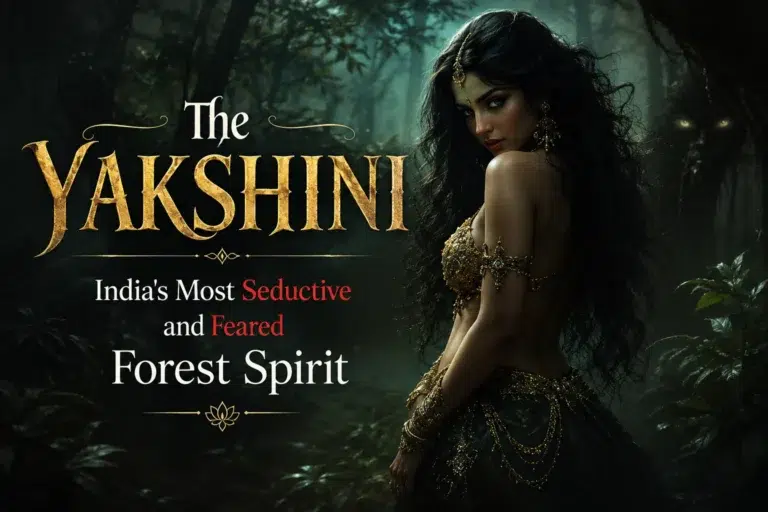
Also Read: Yakshini The Most Seductive and Feared Female Spirit
The Pishacha in the Atharvaveda — The Oldest Record of the Flesh-Eater
The Atharvaveda is the primary source for early Pishacha lore, and it does not treat these beings lightly.
Unlike the Rigveda, which is largely concerned with hymns to the gods, the Atharvaveda is a manual of practical magic — spells for healing, love, protection, and the warding off of evil. Pishachas appear throughout its hymns as one of the primary supernatural threats to human health and sanity. They are grouped alongside Rakshasas (demons of pride and war) and Yatus (sorcery-demons), but distinguished from both by their specific association with disease, madness, and the desecration of the dead.
Several Atharvavedic hymns are explicitly directed against Pishacha attack. One category of affliction called grahi — a seizure or possession — was believed to be caused by a Pishacha entering the body of a living person. Symptoms included sudden behavioural change, violent fits, loss of speech, and an unnatural attraction to cremation grounds or raw meat. The Vedic physician-priest (bhishaj) was called not just to treat the illness but to expel the demon causing it.
Importantly, the Atharvaveda describes Pishachas as already ancient — beings that exist at the margins of the cosmic order, in the darkness between the world of the living and the world of the dead. They are not created by any god. They simply are.
What Does a Pishacha Look Like? Nature, Form, and Habitat
Classical Sanskrit texts — including the Vishnu Purana, the Mahabharata, and various tantric manuals — give us a composite picture of the Pishacha’s appearance. It is not reassuring.
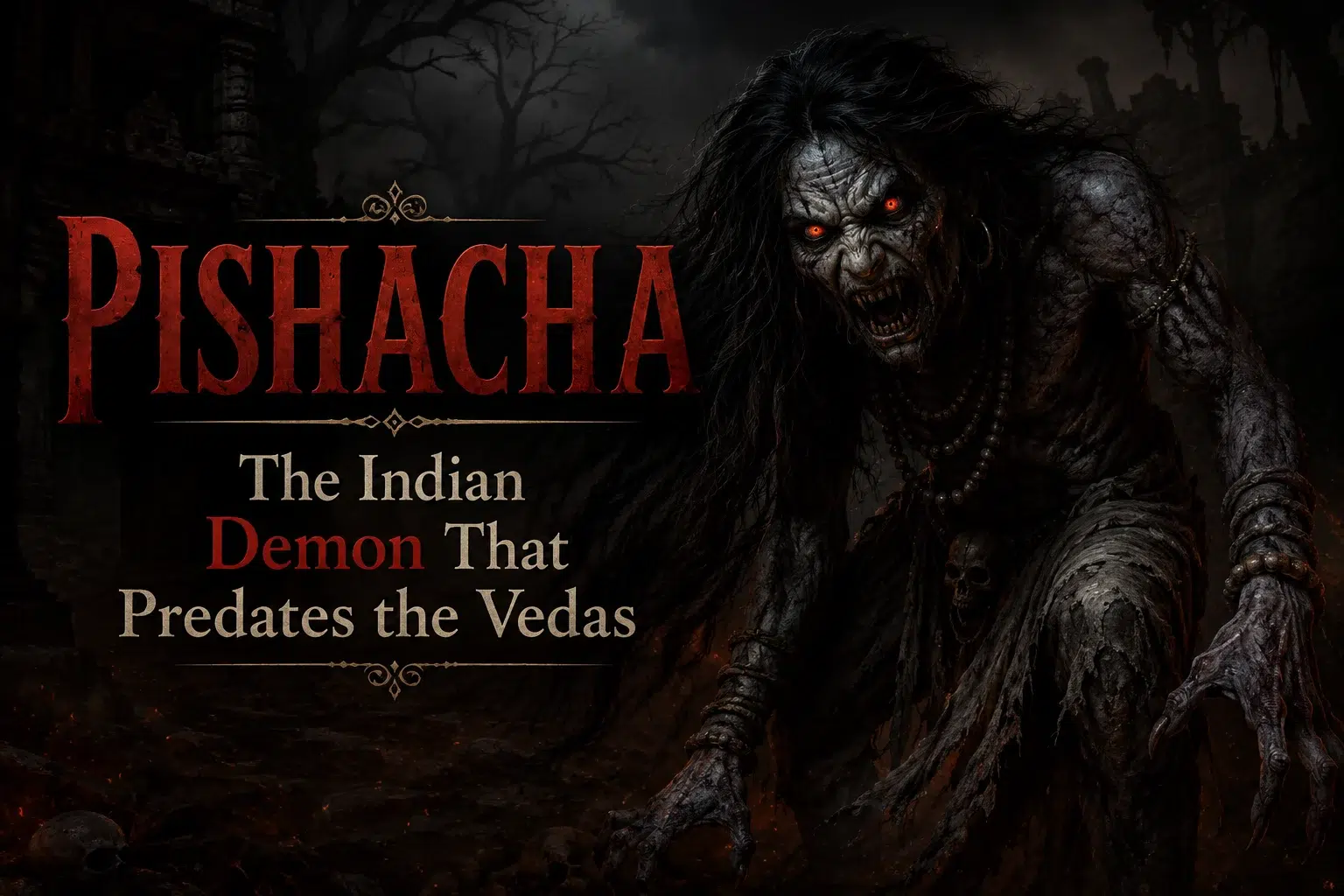
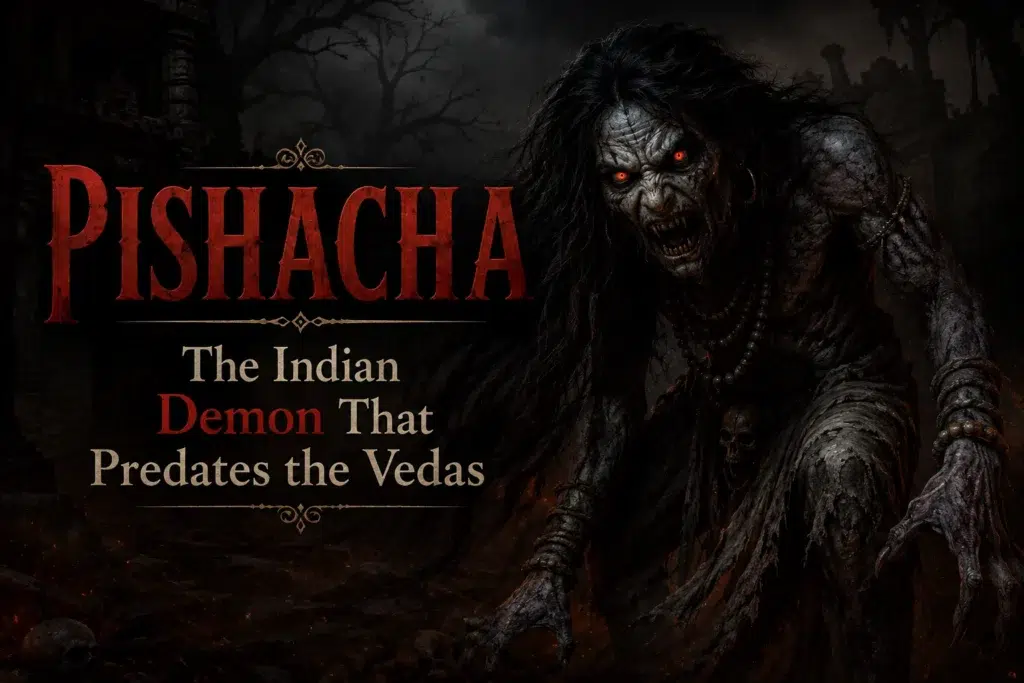
The Pishacha is typically described as emaciated and grotesque: dark or copper-coloured skin stretched taut over visible bones, bulging veins, sunken eyes that glow faintly in the dark, and a mouth stained with blood and gore. It moves with unnatural speed and is capable of shapeshifting — appearing as a recently deceased person to trick the grieving, or as a stray animal near cremation sites. Unlike the Rakshasa, which is often depicted as massive and powerful, the Pishacha is more insidious: it is a creature of stealth and contamination.
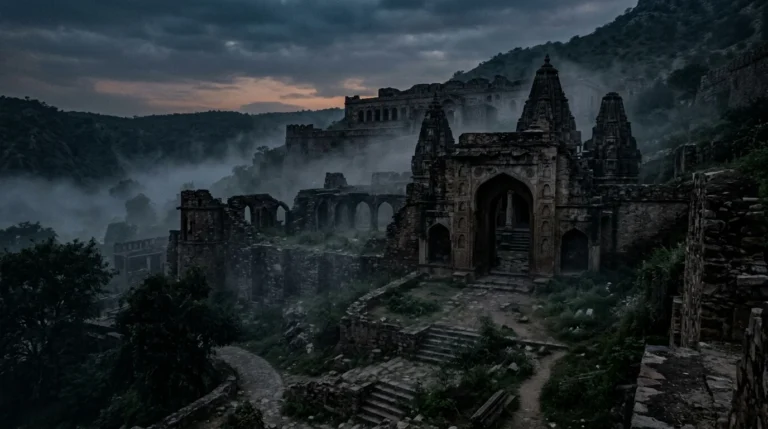
Its habitat is defined by death and waste. Cremation grounds (shamshan), battlefields left uncleared, places where corpses have been improperly buried, the roots of certain trees at midnight, crossroads where the living and dead worlds are thought to overlap — these are its territories. The Pishacha is drawn to pollution in the ritual sense: spaces where the boundary between the living and the dead has been violated or neglected.
It feeds on human flesh and fluids — specifically those of the recently dead, though advanced texts suggest it can be driven to attack the living when the dead are scarce. It is also attracted to ucchishtha — leftover food, especially food that has been contaminated or left out at night. This made it a persistent presence in the folk imagination of agricultural communities, where improper food disposal was a real and daily concern.
How the Pishacha Possesses Humans
The Pishacha possession — called Pishacha-graha in classical texts — is one of the most elaborately documented forms of supernatural affliction in Indian medical and ritual literature.
The Charaka Samhita and Sushruta Samhita, the foundational texts of Ayurvedic medicine, both include sections on graha (supernatural seizure). Among the grahas listed, the Pishacha-graha is characterized by: sudden personality change, violent or obscene speech, attraction to filth and raw meat, loss of social inhibition, erratic physical movements, and intermittent periods of apparent normalcy. A modern reader will immediately recognize these as descriptions of certain acute psychiatric episodes — and that is precisely the point. The Pishacha was the pre-modern Indian framework for understanding what we now call possession, psychosis, or dissociative states.
The mechanics of possession, as described in tantric texts, work like this: the Pishacha typically enters through the mouth (which is why many Indian protective traditions involve not eating in polluted spaces or at liminal times) or through a wound. It displaces or suppresses the person’s own consciousness and uses the body as a temporary vessel. The possessed individual often has no memory of what happens during the possession episode.
What makes Pishacha possession different from possession by other spirits is its contaminating quality — the belief that a Pishacha-possessed person can spread the affliction, that their touch or their breath in an enclosed space could open others to attack.
Regional Names — The Pishacha Across Indian States
One of the most remarkable things about the Pishacha in Indian folklore is how completely it has penetrated every regional tradition, while taking on a different name and slightly different character in each one.
Punjab and Northwestern India
In Punjab, the flesh-eating demon of cremation grounds is often called Muhnochwa or blended with the broader category of bhoot (ghost). The classical Pishacha traits — possession, attraction to death sites, nocturnal activity — are all present. Folk songs and stories from the region frequently warn against sleeping near cremation grounds or eating food left outside overnight, both direct survivals of Atharvavedic Pishacha lore.
Bengal and Eastern India
In Bengal, the Pishach (the Bengali form) is a well-established figure in folk terror, distinct from the bhoot (ghost of the dead) and the petni (female ghost). The Pishach in Bengali tradition is specifically a demon — not a dead person’s spirit — and is associated with madness-causing possession. The Mangalkavya tradition references Pishachas as agents of disease and forest danger. In Assam and Tripura, closely related spirits go by local tribal names but carry the same profile: flesh-craving, possessing, cremation-ground-haunting.
Rajasthan and Central India
In Rajasthan, the Pishacha appears prominently in tantric sadhana texts as one of the lower categories of being a practitioner might encounter — or unwisely attempt to command. Folk exorcism traditions in rural Rajasthan explicitly name the Pishach as a distinct category of possessing spirit, requiring different treatment from a bhoot or churel. In the tribal communities of Madhya Pradesh and Chhattisgarh, the flesh-eating spirit goes by names in Gondi, Chhattisgarhi, and Oraon languages, but the ritual response is remarkably consistent with the Vedic original.
South India
In Tamil Nadu, the Pichachu or Pey shares significant traits with the Pishacha — a malevolent spirit of the cremation ground that causes possession and disease. The Pey appears in Sangam-era Tamil poetry (among the oldest literary texts in the world), suggesting that this class of demon was not simply imported from northern Sanskrit tradition but had deep independent roots in Dravidian folk religion. In Kerala, the Pishacha overlaps with certain categories of kolam (spirit forms) that inhabit impure spaces.
Pishacha vs. Other Demons of Indian Mythology
| Demon | Primary Nature | Habitat | Method of Harm | Weakness |
|---|---|---|---|---|
| Pishacha | Flesh-eater, possessor | Cremation grounds, battlefields | Possession, disease, madness | Iron, salt, Atharvavedic mantras |
| Rakshasa | Warrior demon, shape-shifter | Forests, Lanka, night | Direct attack, illusion | Brahmastra, sacred fire, divine weapons |
| Preta | Hungry ghost of the dead | Liminal spaces | Haunting, craving, attachment | Proper funeral rites, Gaya shraddha |
| Vetala | Corpse-inhabiting spirit | Cremation trees, corpses | Possession of dead bodies | Mantras, correct ritual disposal |
| Bhuta | Ghost of violently/improperly dead | Death site, crossroads | Haunting, attachment, poltergeist activity | Iron, exorcism, offering meals |
The Pishacha is unique in this company because it is not the ghost of a person — it is an independent demonic entity, older than any individual death. That is what makes it harder to appease than a preta or bhuta. You cannot satisfy it with funeral rites. You can only drive it away.
Rituals to Repel the Pishacha — Region by Region
Across India, the ritual technology for dealing with Pishachas is ancient, varied, and surprisingly consistent in its core logic.
Iron is the most widespread protective material. Iron nails driven into doorframes, iron bangles worn on the wrist, iron tools kept near sleeping children — this tradition runs from the Atharvaveda all the way to contemporary village practice across north and central India. The logic is that Pishachas, as pre-Vedic entities of a lower material plane, cannot tolerate the refined power of forged metal.
Salt scattered at thresholds is another pan-Indian protective practice with clear Pishacha-repelling intent. Rock salt (sendha namak) in particular is considered ritually pure, and lines of salt at doorways are still maintained in many households in UP, Bihar, and Rajasthan specifically to prevent nocturnal demon entry.
The Atharvaveda mantras — specifically the hymns of Book 2 and Book 8 — were recited by bhishaj (healer-priests) during possession episodes. These are still used in modified form by ojhas (tribal exorcists) and folk healers across Jharkhand, Bihar, and eastern UP, often combined with drumming, fire, and strong-smelling herbs like neem and asafoetida (hing), which Pishachas are said to find intolerable.
In Kerala, the repelling ritual for a Pishacha-type affliction typically involves a kola performance — an all-night ritual in which a spirit medium embodies the possessing entity to negotiate its departure, accompanied by specific percussion patterns and offerings. In Bengal, the ojha or gunin uses a combination of Sanskrit mantras, local invocations, and physical elements (mustard seed, iron filings, turmeric paste applied to the patient’s body) in an exorcism that can last several days.
What unites all these regional practices is the core logic of the Atharvaveda itself: the Pishacha is repelled not by combat but by purification. You clean the space. You cleanse the body. You invoke a power older and greater than the demon. And you make it uncomfortable enough to leave.
The Pishacha in Modern Indian Ghost Stories
The Pishacha has not retired. It has simply changed address.
In contemporary Indian horror fiction, web series, and cinema — from the Tamil film Pisaasu (2014) to countless Hindi horror productions — the flesh-eating demon of the Atharvaveda survives as a cultural shorthand for the most primal category of supernatural threat: not the ghost of someone you once knew, but an ancient, hungry thing that was never human and has no interest in being understood.
In tribal communities across the Deccan plateau and the Vindhya ranges, belief in the Pishacha as a real and present danger remains entirely unironic. Exorcists are still called. Rituals are still performed. Iron is still worn. The demon that the Vedic composers inherited from whatever came before them is still, three thousand years later, doing exactly what it has always done — haunting the edges of human settlement, waiting near the places where the living meet the dead.
Some things are simply too old to die.
Frequently Asked Questions
What is a Pishacha in Hindu mythology?
A Pishacha is a class of demon in Hindu mythology associated with flesh-eating, possession of the living, and haunting cremation grounds and places of death. Unlike ghosts (bhutas or pretas), which are spirits of dead humans, the Pishacha is an independent demonic entity — possibly pre-Vedic in origin — with no prior human existence. It appears in the Atharvaveda as one of the primary supernatural causes of disease and madness.
Is the Pishacha older than the Vedas?
Most scholars believe the Pishacha concept predates the composition of the Vedas in its current form. The Atharvaveda treats Pishachas as beings already known and feared, not as newly named threats. The connection to Paisachi — an ancient, possibly pre-Sanskrit dialect said to be the Pishacha’s own language — suggests that these beings entered Hindu mythology from older, possibly Dravidian or proto-Indian folk traditions.
What is the difference between a Pishacha and a Rakshasa?
A Rakshasa is a powerful, often intelligent demon of Vedic and epic mythology — a warrior being capable of illusion and direct combat. The Pishacha is lower in the demonic hierarchy, associated with filth, disease, and stealth rather than power and warfare. Rakshasas have complex motivations and appear as antagonists in epics like the Ramayana. Pishachas are more animalistic — they are driven by hunger rather than ambition.
How does a Pishacha possess a person?
According to classical Ayurvedic and tantric texts, a Pishacha enters the body through the mouth or an open wound, particularly in polluted places or at liminal times (midnight, twilight, eclipses). The possession (Pishacha-graha) manifests as sudden personality change, violent or obscene behaviour, attraction to raw meat or cremation grounds, and loss of social inhibition. The possessed person often has no memory of the episode.
What rituals protect against the Pishacha?
The most common protective measures across India include keeping iron objects near the bed or at doorways, scattering salt at thresholds, burning neem leaves or asafoetida to create repellent smoke, and reciting Atharvavedic mantras. Regional exorcism traditions in Kerala, Bengal, Rajasthan, and the tribal belts of central India all have specific ritual protocols for expelling a Pishacha from a possessed person, typically involving purification of both the individual and the surrounding space.
What are the regional names for the Pishacha?
The Pishacha is known by different names across India: Pishach in Bengal and Hindi-speaking regions, Pichachu or Pey in Tamil Nadu, Pisacha in Kannada and Telugu traditions, and various tribal-language equivalents in Gondi, Oraon, and Santali. Despite the name differences, the core characteristics — flesh-eating, possession, cremation ground habitat, and nocturnal activity — remain consistent across regions.
Does the Pishacha appear in modern Indian culture?
Yes. The Pishacha appears in contemporary Indian horror films, web series, and fiction as a category of ancient demonic threat distinct from ordinary ghosts. The 2014 Tamil horror film Pisaasu drew directly on this mythology. In tribal and rural communities across central and eastern India, belief in the Pishacha as a real presence remains active, and exorcism rituals continue to be performed by local healers and ojhas today.
The Oldest Monster Is Still Hungry
The Pishacha — India’s flesh-eating demon — is remarkable not because it is frightening (though it is), but because it is persistent.
It survived the Vedic synthesis. It survived the rise of Buddhism and Jainism. It survived the medieval bhakti movement, colonial modernity, and the age of cinema and smartphones. It is still there, in the footnotes of ancient manuscripts and the whispered warnings of village elders, in the exorcism drums of the Jharkhand forest and the iron nails driven into the doorframes of farmhouses in UP.
Whatever the Pishacha originally was — the demonized spirit of a pre-Vedic culture, the mythological expression of disease and death, the name ancient people gave to the terror of the cremation ground at midnight — it tapped into something so fundamental in the human experience of mortality and contamination that no amount of modernity has been able to dislodge it.
Three thousand years of civilization, and the flesh-eater is still at the door.
Exploring the deep roots of India’s supernatural traditions? Read more about ancient Indian demons, Vedic mythology, tribal spirit beliefs, and the folklore that has shaped South Asian culture for millennia on our blog.