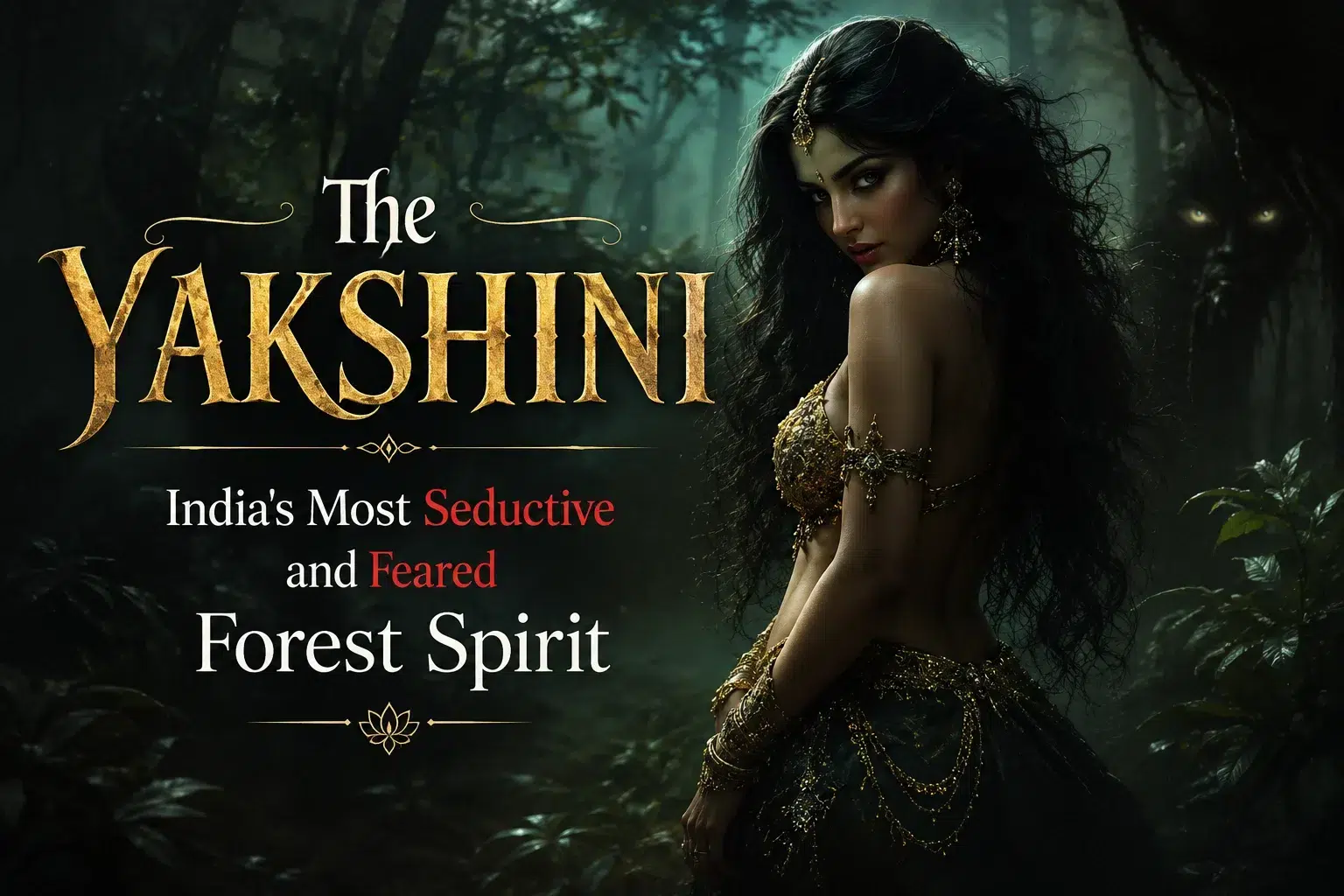
I grew up hearing about her from my grandmother.
She called her the vana-devi — the goddess of the wild. But she wasn’t quite a goddess. She was something older, stranger, and far more dangerous. A Yakshini. A spirit who lived in trees, guarded buried treasure, and lured wandering men deep into the forest where no one would find them again.
I didn’t take it seriously then. Now, after years of reading Vedic texts, Buddhist sutras, Jain manuscripts, and the folk stories of Kerala, Bengal, and Rajasthan, I understand why she has endured for over three thousand years.
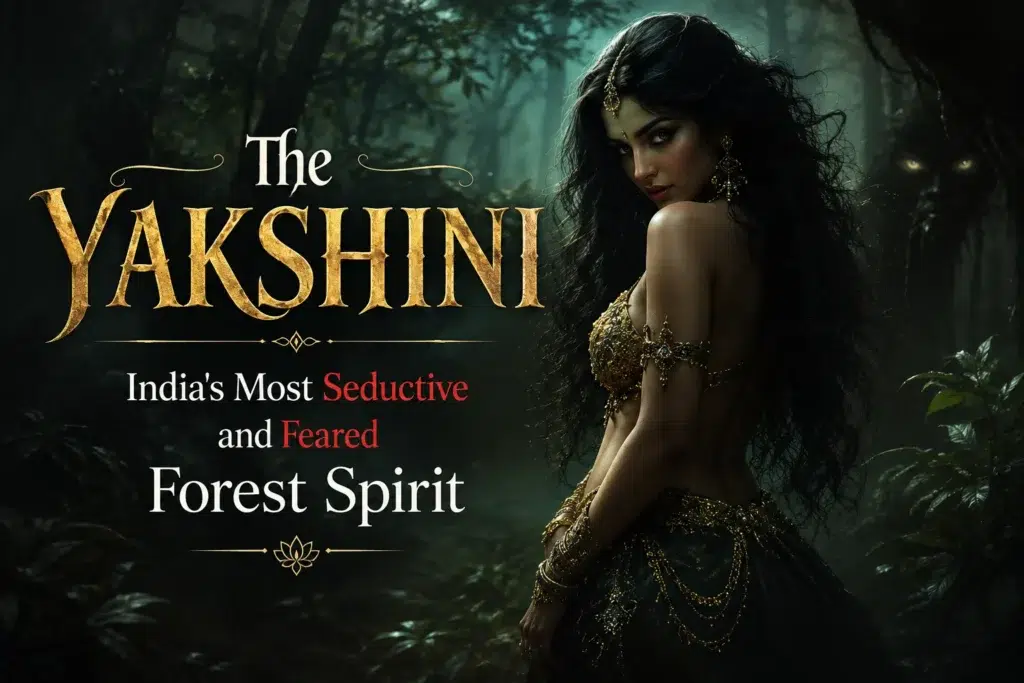
The Yakshini of Indian mythology is not just a ghost story. She is one of the most complex, layered, and misunderstood figures in all of South Asian spiritual tradition — equally adored and feared, worshipped and warned against, seductive and terrifying. And she is very much still alive in the tribal forests of India today.
Who Is the Yakshini? The Origins in Vedic Texts
The word Yakshini (also spelled Yakshi or Yakkhini) comes from the Sanskrit root yaks, meaning to worship, to be swift, or to shine. Her male counterpart is the Yaksha — a nature spirit associated with wealth, forests, and fertility. Together, Yakshas and Yakshinis form one of the oldest categories of supernatural beings in the Hindu tradition, predating even the classical Puranas.
In the Atharvaveda, one of the four sacred Vedic texts, Yakshas are described as powerful, semi-divine beings connected to hidden treasure and the deep forest. The early Vedic tradition didn’t view them as evil — they were ambiguous beings, neither fully divine nor fully demonic. They existed in the in-between spaces: the roots of old trees, the deep riverbanks, the crossroads at midnight.
The Yakshini, specifically, emerged as the feminine form of this wilderness power. She was understood to be beautiful beyond description, capable of shapeshifting, and bound to a specific tree or place. Touch her tree, disrespect her space, or wander into her forest alone after dark — and you invited her attention. That attention was not always welcome.
Early Sanskrit literature described her as a vriksha-devata — a tree goddess — whose life force was linked directly to her tree. If the tree was cut, she was wounded. If it flourished, she thrived. This ecological bond made her one of the earliest examples of nature-spirit worship in the Indian subcontract, a tradition that predates formal temple religion by centuries.
The Yakshini in Buddhist and Jain Mythology
What makes the Yakshini in Buddhist and Jain mythology particularly fascinating is how dramatically her role shifts between traditions.
In Buddhist texts, the Yakkhini (Pali form of Yakshini) appears throughout the Jataka Tales and the Pali Canon. She is often a threat — a predatory female spirit who lurks near cremation grounds, forest paths, and riverbanks. In one famous tale, a Yakkhini disguises herself as a beautiful woman to seduce and devour travellers. Only the morally pure — the monk, the righteous layman — can resist her enchantments.
But the Buddhist tradition also shows another side. Several Yakkhinis convert to Buddhism after encounters with the Buddha or his disciples. In the Petavatthu (Stories of the Departed), Yakkhinis who reform become protectors of the Dharma. This dual portrayal — hungry demon and potential devotee — reflects the Buddhist view that no being is beyond redemption.
Jain mythology treats the Yakshini with even more reverence. In the Jain tradition, each of the 24 Tirthankaras (enlightened beings) is paired with a protective goddess called a Shasandevata. Many of these are Yakshinis. Chakreshvari, the guardian of the first Tirthankara Rishabhanatha, is a Yakshini. So is Padmavati, the beloved protector of Parshvanatha. These are not forest demons — they are venerated, depicted in temple sculpture, and worshipped by Jain communities across India to this day.
The contrast is striking: the same spirit who devours travellers in Buddhist legend sits enthroned as a divine protector in Jain temples. This is what makes the Yakshini so endlessly fascinating — she refuses to be reduced to a single meaning.
Also Read: Vetala The Demon that rides the corps
Regional Variations: Kerala, Bengal, and Rajasthan
The Yakshini in regional folklore takes on distinctly local flavours across India. Three regions in particular have developed rich, detailed traditions around her.
The Yakshi of Kerala
In Kerala, the Yakshi is perhaps the most vivid and widely known version of the spirit. She is specifically associated with the pala tree (Alstonia scholaris), which blooms at night with a powerfully intoxicating fragrance. According to Kerala tradition, the Yakshi inhabits this tree and uses the scent to draw men toward her in the darkness.
The classic Kerala Yakshi narrative involves a lone male traveller, a beautiful woman appearing at a crossroads or under a pala tree at night, and a seduction that ends in the man’s death — often by the woman revealing her true form: a spirit with reversed feet, fanged teeth, and wild hair. In some versions, she feeds on the liver of her victims.
But Kerala’s relationship with the Yakshi is not simply one of fear. In many households and kavus (sacred groves), the Yakshi is also worshipped as a protective mother spirit. The same being who destroys the immoral wanderer also guards the family’s land. Her anger is not random — it is moral. She punishes those who come to the forest with bad intentions, and she protects those who honour her.
The Yakkhini of Bengal
In Bengal and eastern India, the Yakkhini blends with the broader tradition of shakti worship and the fierce feminine divine. She appears in Bengali folk stories as a spirit of river forests and bamboo groves, sometimes helpful, sometimes deadly. In some versions, she takes the form of a beautiful widow or a lost woman asking for help.
The Mangalkavya texts of medieval Bengal reference Yakkhinis as attendants of the goddess Manasa (the serpent goddess) and Shitala (the goddess of disease). This places the Yakshini firmly within the ecosystem of folk religion — not quite a deity, but far more than a mere ghost. She is part of the spiritual infrastructure of the Bengali countryside.
The Yakshini of Rajasthan
In Rajasthan, the Yakshini appears most prominently in the context of tantric sadhana — spiritual practice aimed at harnessing supernatural power. Ancient tantric texts from the region describe rituals by which a sadhu (ascetic) could summon and bind a Yakshini, compelling her to serve as a supernatural companion, granting him wealth, knowledge, and magical abilities.
These rituals were dangerous. The texts are explicit: one mistake in the procedure, and the Yakshini would turn on the practitioner. The 64 Yakshinis listed in classical tantric texts (such as the Mantra Maharnava) each have specific names, forms, trees, and offerings. Each is a complete spiritual entity with her own personality and domain. Rajasthani miniature paintings occasionally depict Yakshinis as celestial dancers — apsara-like figures floating in forest clearings, simultaneously divine and perilous.
The Yakshini in Sculpture and Temple Art
You cannot visit the great temples of India without encountering her.
The Yakshini of Indian temple sculpture — most famously the Didarganj Yakshi (circa 3rd century BCE, now in the Patna Museum) — is one of the masterpieces of ancient Indian art. Her polished sandstone form radiates physical power and sensuality. She holds a chauri (fly-whisk) and stands in a gentle tribhanga (three-bend) pose. She is not frightening in the sculpture. She is magnificent.
At Sanchi, Bharhut, and Amaravati — the great Buddhist stupa sites — Yakshinis adorn the gateways (toranas). Art historians believe they were placed there as guardians and fertility blessings: beings powerful enough to protect the sacred space. Their iconography — full breasts, heavy hips, a hand touching or wrapping around a tree — explicitly links them to the abundance of the natural world.
This sculptural tradition tells us something important: the Yakshini was not always feared. She was respected. Placed at the threshold of sacred space, she was an invitation to the divine and a warning to those who approached with impure intention.
Why the Yakshini Still Haunts Tribal Folklore Today
Across the forests of Jharkhand, Chhattisgarh, Odisha, and the northeastern states, tribal communities maintain living traditions of Yakshini worship that have changed little in centuries.
Among the Gond, Santali, and Oraon peoples, the forest spirit — known by local names that map onto the Yakshini archetype — is understood as a real presence. She is propitiated before timber is cut. She is offered flowers, turmeric, and rice wine at the base of large trees. Villagers still warn each other not to urinate near peepal or banyan trees at night, not to speak disrespectfully in the forest, not to enter certain groves after dark.
These are not superstitions preserved out of ignorance. They are ecological memory encoded in spiritual language — the deep knowledge that the forest is alive, that certain spaces are sacred, and that human intrusion without respect has consequences. The Yakshini, in this light, is not a monster. She is the forest itself, asserting its right to be treated with care.
The rise of deforestation across central India has given these traditions renewed urgency. In communities where Yakshini worship remains active, sacred groves (devban or sarna) are often the last surviving patches of old-growth forest. The spirit protects the tree. The belief in the spirit protects the ecosystem. The Yakshini, it turns out, is also a conservationist.
Yakshini vs. Other Indian Female Spirits — A Quick Comparison
| Spirit | Origin | Nature | Association |
|---|---|---|---|
| Yakshini | Vedic / Pre-Hindu | Ambiguous — protective and dangerous | Forests, trees, fertility, wealth |
| Churel | North Indian folklore | Malevolent | Women who died in childbirth |
| Apsara | Vedic / Hindu | Benevolent / seductive | Heaven, rivers, dance |
| Mohini | Hindu epic | Illusory / trickster | Vishnu’s female form, deception |
| Pishacha | Vedic / Hindu | Malevolent demon | Disease, darkness, possession |
The Yakshini occupies a unique position — neither fully divine nor fully demonic. That moral complexity is precisely what has kept her alive in the imagination for three millennia.
Frequently Asked Questions
What is the difference between a Yaksha and a Yakshini?
A Yaksha is the male nature spirit associated with forests, wealth, and hidden treasure in Hindu and Buddhist mythology. A Yakshini is the female counterpart. While Yakshas are often depicted as guardians of treasure (Kubera, the god of wealth, is their king), Yakshinis are more strongly linked to trees, fertility, and the seductive power of the wild. Both can be benevolent or dangerous depending on context.
Is the Yakshini a goddess or a demon?
Neither, exactly. The Yakshini occupies a middle space in Indian cosmology — more powerful than humans, but below the major devas (gods). She is best understood as a nature spirit: ancient, place-bound, and morally complex. In Jain tradition she is worshipped as a divine guardian; in Buddhist tales she often appears as a predatory spirit. In folk tradition she is both, depending on how she is treated.
What trees are associated with the Yakshini?
Different regional traditions associate different trees with Yakshini. In Kerala, the pala tree (Alstonia scholaris) is most strongly connected to the Yakshi. Across northern India, the peepal (Ficus religiosa), banyan (Ficus benghalensis), and ashoka (Saraca asoca) are all considered Yakshini trees. Tantric texts list specific trees for each of the 64 Yakshinis.
Are there 64 Yakshinis? What are they?
Yes — classical Hindu and Jain tantric texts list 64 Yakshinis, each with her own name, appearance, tree, sacred colour, and domain. Some well-known ones include Vidhyadhari (the knowledge-bearer), Ananga Kusuma (the flower-of-desire), Padmini (the lotus one), and Kanchana (the golden one). Each could be invoked through specific tantric rituals for different purposes — knowledge, wealth, healing, or power.
Why do tribal communities in India still worship the Yakshini?
In many tribal traditions across Jharkhand, Chhattisgarh, Odisha, and northeastern India, the Yakshini (known by local names) represents the living presence of the forest. Worshipping her is a way of maintaining a reciprocal relationship with nature — asking permission before taking resources, and acknowledging that the forest has its own sovereignty. These practices have also served as de facto conservation, protecting sacred groves from deforestation.
Is the Kerala Yakshi the same as the Vedic Yakshini?
They share the same mythological roots, but the Kerala Yakshi has developed into a distinct regional figure with her own specific iconography, narratives, and ritual traditions. The Kerala Yakshi is closely tied to the pala tree, the night, and the seduction-and-death narrative that is particularly vivid in Malayali folklore. The Vedic Yakshini is a broader, more general category of nature spirit.
Has the Yakshini appeared in Indian literature and cinema?
Absolutely. The Yakshi appears famously in the 1968 Malayalam novel Yakshi by Malayattoor Ramakrishnan, which became a landmark of modern Indian horror literature. She also appears in Sanskrit dramas, medieval Bengali poetry, and more recently in Indian cinema and graphic novels. The archetype of the beautiful, deadly woman in the forest continues to be reimagined in contemporary Indian storytelling.
The Yakshini Will Not Be Forgotten
Three thousand years after she first appeared in the Vedic imagination, the Yakshini — India’s most seductive and feared forest spirit — shows no sign of fading.
She has outlasted empires, survived the arrival of new religions, adapted to regional cultures across an entire subcontinent, and persisted in the living memory of communities who still leave offerings at the feet of old trees. She is, in the truest sense, undying.
Perhaps that is because she is not really supernatural at all. She is the forest speaking in a language humans could understand — beautiful, dangerous, generous to those who approach with respect, and merciless to those who do not.
The next time you walk through an old forest at dusk and feel that peculiar sensation — that someone is watching from the shadows between the trees — now you know who it might be.
Fascinated by India’s ancient mythology and forest traditions? Explore more deep dives into South Asian folklore, Vedic spirits, and tribal wisdom traditions on our blog.