Table of Contents
I grew up hearing the Vikram and Betal stories on Doordarshan, the old animated show where a fearless king chased a demon through a forest night after night. I thought it was just a children’s tale. It wasn’t until I studied Indian folklore seriously that I realized those stories were sitting on top of one of the oldest, strangest, and most philosophically rich supernatural traditions in the world — the legend of the Vetala, India’s original vampire.
If you’ve been searching for “Indian vampire folklore,” “what is a Vetala in Hindu mythology,” or “how is the Vetala different from Western vampires” — you’re in exactly the right place. This post covers everything: the ancient texts, the origin of Vikram and Betal, how the Vetala compares to Dracula, and where this demon shows up in modern Indian horror cinema.
What Exactly Is a Vetala in Indian Mythology?
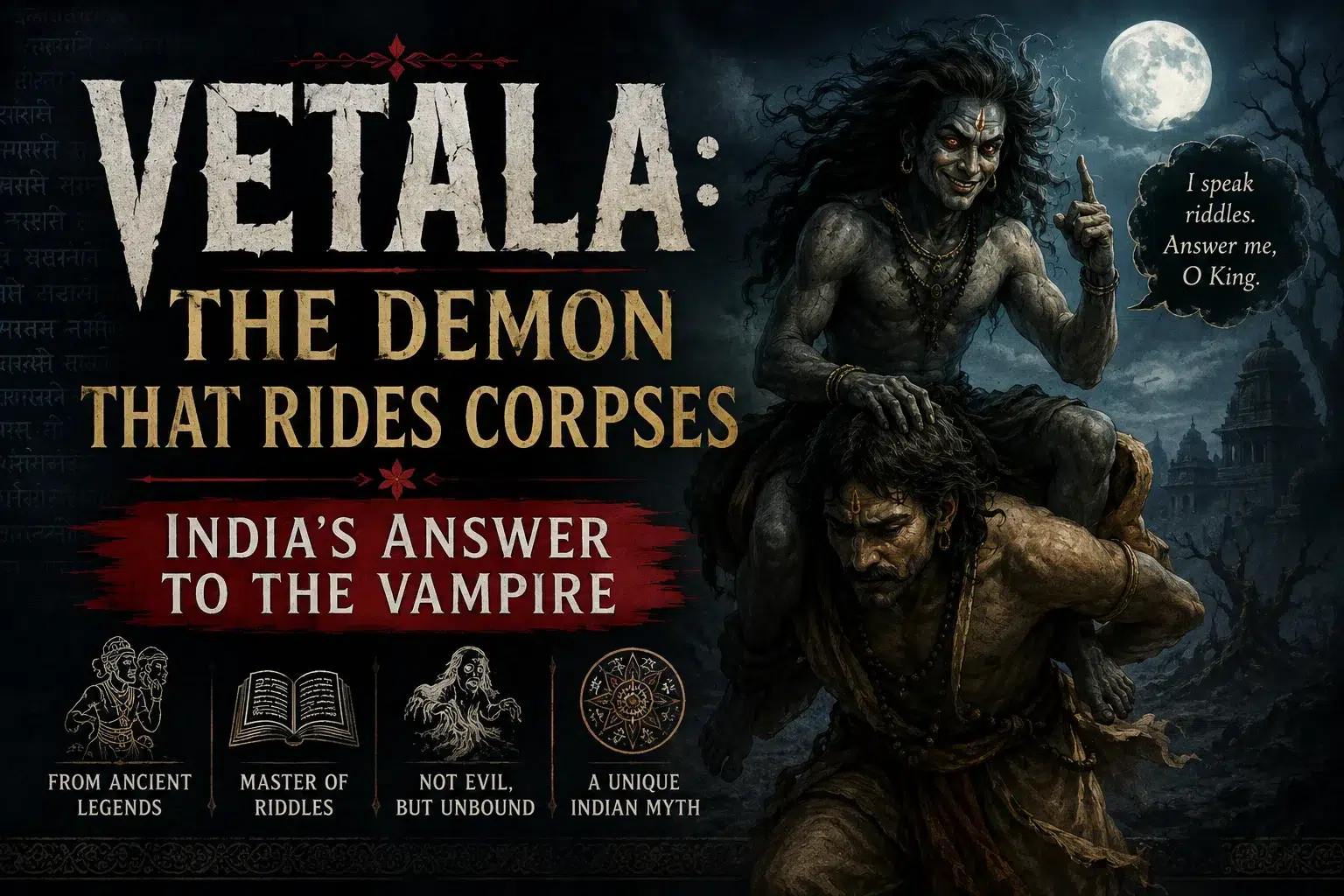
The Vetala (also spelled Baital, Betal, or Vetalas) is a supernatural entity from Hindu mythology that inhabits and animates human corpses. The word itself comes from Sanskrit — veta meaning corpse, and the suffix ala roughly meaning “one who dwells.” So a Vetala is literally a spirit that lives inside a dead body.
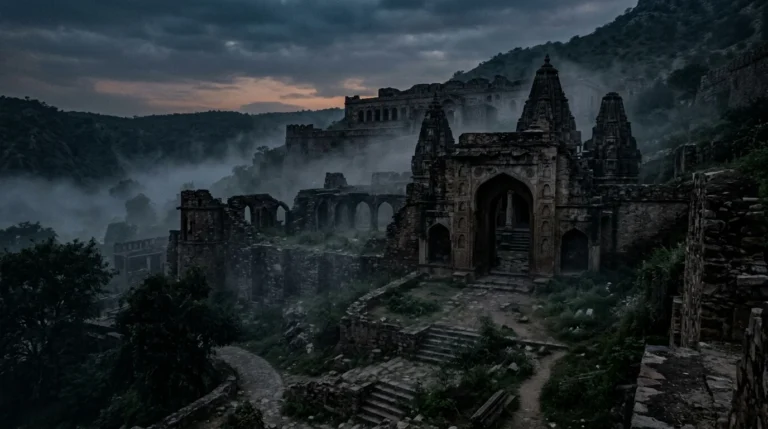
But here’s where it gets interesting. Unlike the shambling, mindless undead of Western horror, the Vetala is described in ancient texts as highly intelligent, razor-witted, and even philosophically sophisticated. It hangs upside down from trees in cremation grounds — much like a bat — and can enter and control a corpse at will.
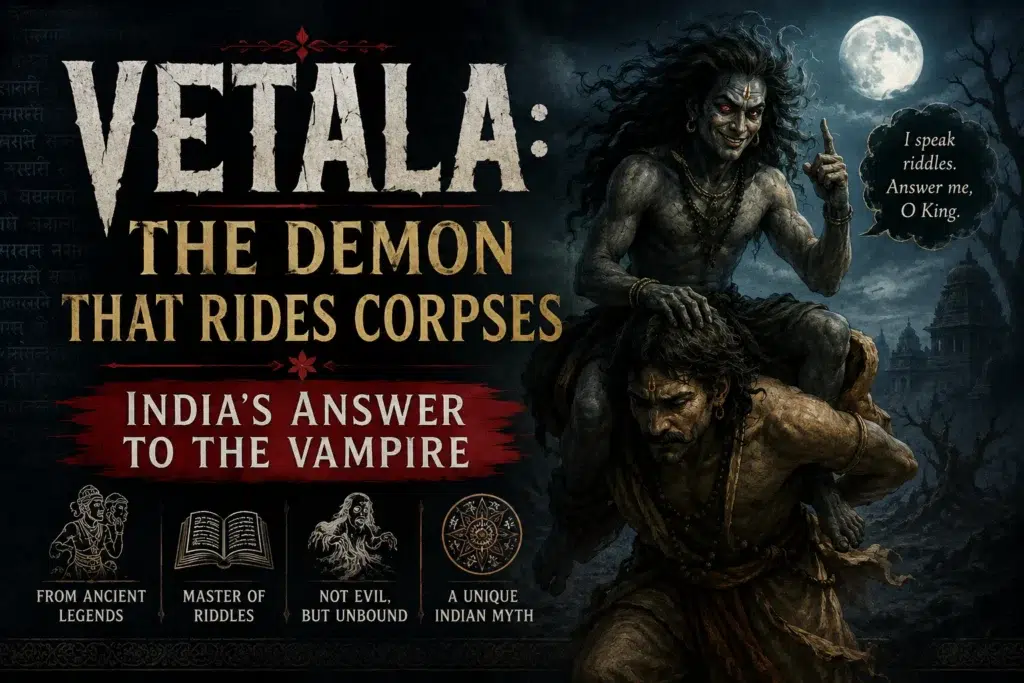
The Vetala is not purely evil in the traditional sense. It occupies a strange middle space between the world of the living and the dead, which in Hindu cosmology is considered a place of great power — and great danger.
The Ancient Texts: Where Vetala Mythology Comes From
The earliest detailed mention of the Vetala in Hindu texts appears in the Baital Pachisi — a Sanskrit collection meaning “Twenty-Five Tales of Baital.” This text is believed to date back to the 11th century CE, though scholars suggest the oral traditions behind it are far older, possibly rooted in the Kathasaritsagara (Ocean of Streams of Story), compiled by the Kashmiri poet Somadeva around 1070 CE.
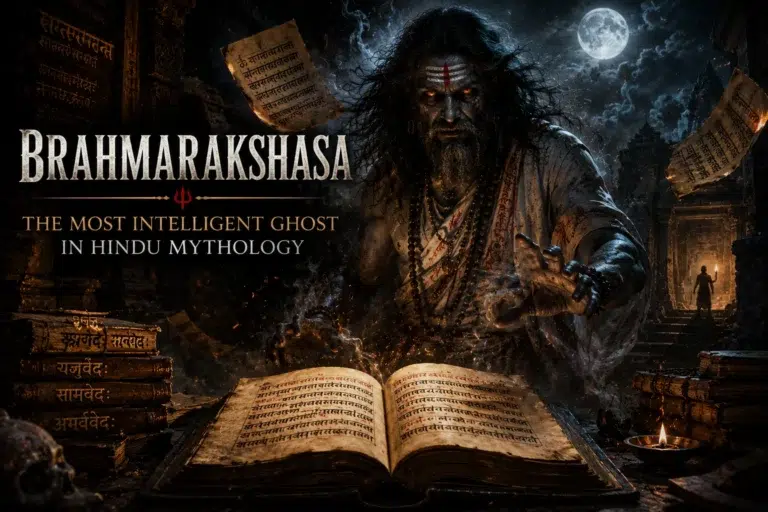
The Vetala also appears in the Markandeya Purana and in Tantric literature, where Vetalas are described as attendants of Shiva, haunting cremation grounds alongside other supernatural beings like Bhutas and Pisachas. In Tantric practice, a yogi who could control a Vetala was considered to have gained tremendous occult power.
This is a crucial distinction. In Vedic and Tantric traditions, the cremation ground is a sacred space, not merely a place of death. Shiva himself meditates there. The Vetala, by inhabiting this liminal zone, carries an aura that is simultaneously terrifying and spiritually significant.
Vikram and Betal: The Story That Made Vetala Mythology Famous
The most famous version of Vetala folklore in India comes through the legendary tale of King Vikramaditya — the great and wise ruler from Ujjain — and the Betal (Vetala) who hangs from a tree in a cremation ground.
A sorcerer tricks King Vikram into fetching the Betal for him. Night after night, Vikram enters the burning ground, takes the corpse down from the tree, and begins the long walk back. Each time, the Betal tells him a puzzling story — and at the end of each story, asks him a moral riddle. If Vikram knows the answer and stays silent, his head will split open. If he speaks, the Betal flies back to the tree and Vikram must start again.
What makes this cycle so remarkable is the intellectual contract between the king and the demon. The Betal doesn’t attack Vikram. It tests him. The riddles it poses are genuine ethical dilemmas — questions about dharma, loyalty, guilt, and justice — and Vikram’s answers reveal his character.
This is not a monster-versus-hero story. It’s a philosophical dialogue carried by a walking corpse. The Vetala functions as a dark teacher, a supernatural Socrates who forces a king to think clearly in conditions of fear and exhaustion.
The tales were later compiled in Hindi by Surdas’s contemporary poets and retold countless times across regional languages, from Bengali to Marathi to Tamil.
How the Vetala Compares to the Western Vampire
This is where things get genuinely fascinating. On the surface, the Vetala and the European vampire share a striking list of traits: both are undead entities, both inhabit corpses, both haunt the space between life and death, and both are traditionally connected to cremation grounds or graveyards.
But the differences run deep.
| Feature | Vetala (Indian) | Vampire (Western) |
|---|---|---|
| Origin | Sanskrit/Hindu mythology | European folklore (Slavic, Romanian) |
| Nature | Spirit inhabiting a corpse | Undead human risen from the grave |
| Diet | Not blood-dependent | Feeds on human blood |
| Intelligence | Highly intelligent, philosophical | Cunning but predatory |
| Relationship to humans | Trickster, tester, ambiguous | Predatory, threatening |
| Sacred associations | Connected to Shiva, Tantric power | Associated with evil, anti-Christian forces |
| Weakness | Can be forced to leave a corpse through ritual | Sunlight, garlic, holy symbols |
| Purpose in stories | To pose moral riddles, test the worthy | To terrify, to threaten |
The Western vampire is largely a creature of appetite — it hungers for blood and immortality, and the horror it represents is often linked to sexuality, disease, or aristocratic corruption (think Dracula as a predatory Eastern European nobleman).
The Vetala represents something else entirely: the danger of the in-between. It sits at the boundary of life and death, dharma and adharma, knowledge and ignorance. Its power is not physical consumption but intellectual entrapment. It doesn’t drink your blood. It asks you a question you can’t answer.
Vetala in Marathi Horror Cinema and Modern Indian Culture
The Vetala has not stayed locked in ancient texts. It has made a slow, fascinating return in Indian horror cinema, particularly in Marathi-language films where regional folklore gets more space than in mainstream Bollywood.
The 2022 Marathi horror film Dhyanimani drew on local spirit folklore that overlaps with Vetala traditions — the haunted cremation ground, the possessing spirit, the test of courage and moral clarity.
The Vetala also surfaces in South Indian horror films rooted in Tantric traditions, where possession by a cremation ground spirit (a thinly veiled Vetala type) drives the narrative. The Bhoot Police universe, while comedic, plays with the idea of spirits that inhabit bodies and can be negotiated with — a distinctly Vetala-ish concept.
In Indian comic books and graphic novels, the Vetala has found new life. Amar Chitra Katha’s retellings of Vikram and Betal introduced the myth to millions of Indian children through the 20th century. More recently, Raj Comics’ Bhokal series drew on similar supernatural warrior-king traditions.
The character of Betal in the TV serial — which ran from 1986 to 1988 on Doordarshan — remains one of the most-watched Indian mythological shows ever broadcast. Its haunting title music and the image of the demon hanging upside down in a dark forest is burned into the memory of an entire generation.
Who Should Care About Vetala Mythology Today?
Horror writers and worldbuilders looking for alternatives to tired Western vampire tropes will find the Vetala endlessly generative. A supernatural being that tests your ethics instead of drinking your blood is a genuinely fresh premise for modern horror fiction.
Folklore scholars and mythology enthusiasts will find the Vetala a rich case study in how ancient cultures processed death, liminality, and the boundary between the physical and spiritual worlds.
Indian cinema fans watching the current wave of folk horror — from Tumbbad to Bhoothakaalam — will recognize the Vetala’s fingerprints in the logic of many of these films: the demon that bargains, the spirit that can be outwitted, the sacred horror of the cremation ground.
And for anyone who grew up with Vikram and Betal, revisiting those stories as an adult reveals layers of dharmic philosophy, narrative architecture, and mythological depth that no children’s retelling could fully convey.
Frequently Asked Questions About Vetala Mythology
What is the Vetala in Hindu mythology?
The Vetala is a supernatural entity in Hindu mythology that inhabits and animates dead human bodies. It is described in ancient Sanskrit texts as highly intelligent and is closely associated with cremation grounds, the god Shiva, and Tantric traditions. Unlike simple zombies or ghosts, the Vetala occupies a philosophically significant space between the living and the dead.
What is the difference between a Vetala and a vampire?
While both are undead entities, the Vetala differs from the Western vampire in almost every meaningful way. The Vetala does not feed on blood — its power lies in its intelligence and its ability to pose unanswerable moral riddles. The Western vampire is primarily a predator; the Vetala is a trickster and a tester of human wisdom.
What is the origin of the Vikram and Betal story?
The Vikram and Betal cycle comes from the Baital Pachisi (Twenty-Five Tales of Baital), a Sanskrit text believed to have been formalized around the 11th century CE. It was later incorporated into the Kathasaritsagara by the Kashmiri poet Somadeva. The oral traditions behind the tales are likely much older.
Is the Vetala a demon or a ghost?
In Hindu classification, the Vetala is typically described as neither a full demon (asura) nor a simple ghost (bhuta). It sits in its own category — a type of spirit that possesses corpses and haunts cremation grounds. In Tantric literature, Vetalas are sometimes listed as servants of Shiva, giving them a more ambiguous, powerful status than simple evil spirits.
Does the Vetala appear in modern Indian horror?
Yes. While mainstream Bollywood rarely references the Vetala directly, Marathi horror cinema and South Indian folk horror films have drawn heavily on related traditions. The logic of possession, the haunted cremation ground, and the demon that can be bargained with or outwitted are all Vetala-adjacent ideas that continue to shape Indian horror storytelling today.
Why does the Vetala hang upside down from trees?
Ancient texts describe the Vetala as hanging from trees in cremation grounds between possessions — a posture that mirrors the natural resting position of bats. This detail is one of the intriguing points of overlap between Indian Vetala mythology and European vampire folklore, since bats are also closely associated with vampires. Whether this is coincidence, parallel evolution of horror imagery, or evidence of ancient cultural exchange remains an open scholarly question.
What can defeat a Vetala?
In traditional accounts, the Vetala cannot simply be killed — since it already inhabits a dead body. It can be forced out through Tantric ritual, and in the Vikram and Betal stories, the Vetala ultimately serves a higher purpose and departs voluntarily once its task is complete. Answering its riddles correctly is itself a form of power over it.
The Demon That Still Asks Questions
What I find most striking about the Vetala in Indian mythology is that it doesn’t simply threaten you. It talks to you. It tests you. It wants to know if you’re wise enough, brave enough, and honest enough to deserve the world you’re walking through.
That’s a different kind of horror than the one that comes to drink your blood. It’s the horror of being seen clearly, of having your judgment and character put on trial in a dark forest by something that knows more than you do.
The Vetala is one of the most original, philosophically rich monsters in any mythological tradition on earth. And it has been waiting, upside down in a tree at the edge of a cremation ground, for the rest of the world to finally come and find it.
If you’re exploring Indian folklore, Sanskrit mythology, or the roots of South Asian horror, the Vetala is where you should start.