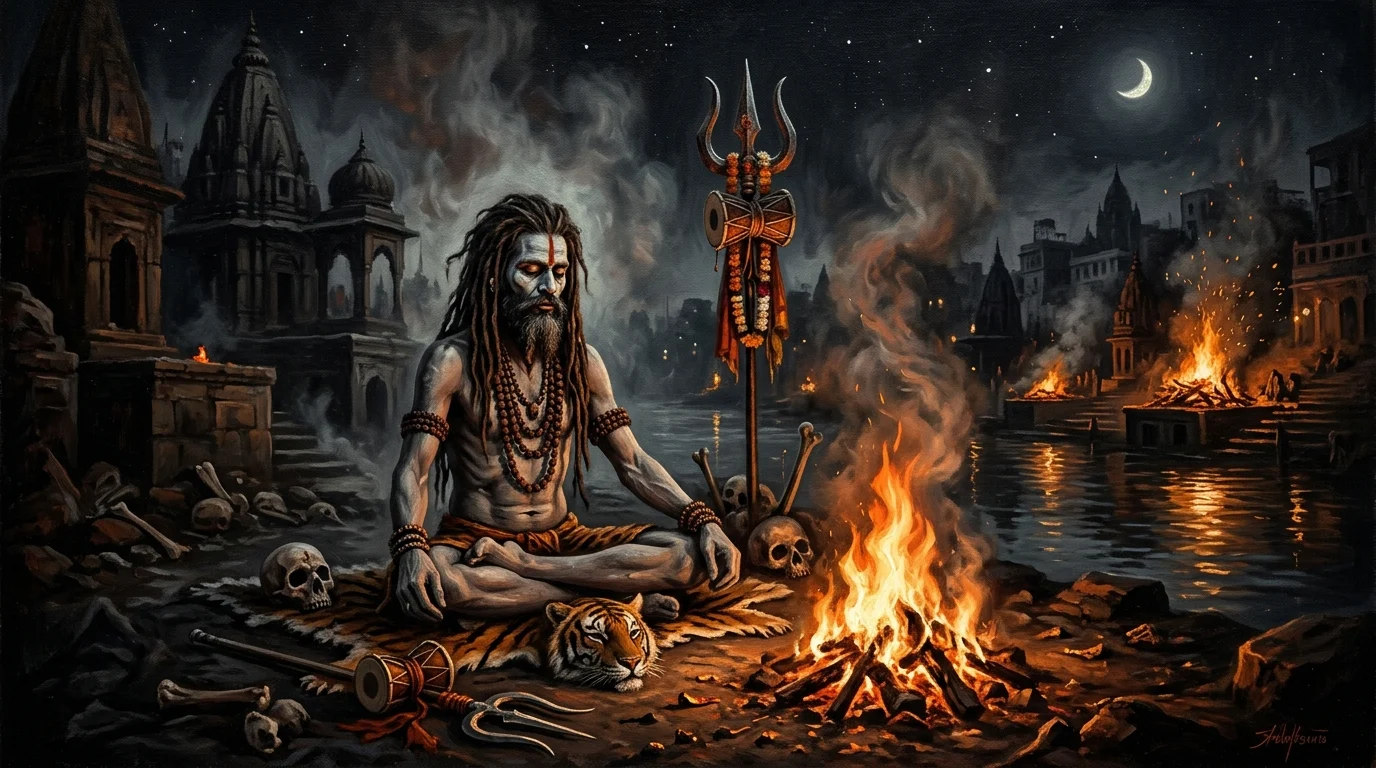
I will never forget sitting on the stone steps of Manikarnika Ghat in Varanasi just past midnight. The air was thick with the scent of burning sandalwood and the unmistakable, sweetish heaviness of consuming pyres. Across the smoke, a figure sat completely motionless, dusted head to toe in white human cremation ash (bhasma), a garland of dried rudraksha resting against his ribs. He didn’t look up at the tourists. He didn’t look at the river. In the eyes of an Aghori, the world has ceased to be divided into sacred and profane.
In Western media and popular Indian television, the Aghoris are often sensationalized as macabre sorcerers or horror movie tropes. But when you step past the shock value and study the authentic Shaivite and Shakta roots of Aghori sadhana, you uncover what is perhaps the most radical, psychologically demanding spiritual philosophy ever conceived in the human mind.
Who Are the Aghoris? The Meaning of ‘A-Ghora’
The Sanskrit etymology provides the first essential key. In Sanskrit, Ghora means terrifying, dark, complicated, or full of dread. Place the prefix A- in front of it, and you get Aghori: that which is non-terrifying, simple, illuminated, and devoid of fear.
To be an Aghori is not to court darkness for the sake of evil. It is the quest to dismantle the illusion of terror altogether. While orthodox spiritual paths pursue purity by rejecting the unclean, the Aghori seeks God by seeing divine consciousness (Brahman) within that which society rejects most violently.
Their spiritual lineage traces back through medieval Tantric sects like the Kapalikas (the skull-bearers) and finds its modern formulation through the 17th-century saint Baba Keenaram, who is revered as an avatar of Lord Dattatreya and the founder of the sacred Aghori seat at Krim-Kund in Varanasi.
Why the Cremation Ground (Smashan) Is the Ultimate Classroom
For ordinary mortals, the cremation ground (Smashan) is the most frightening place on earth. It is where our greatest attachments turn to smoke, where social status, beauty, wealth, caste, and pride vanish into a handful of gray ash. And that is precisely why the Aghori chooses to live there.
In classical Tantra, the cremation ground is called the Mahashmashan the Great Void. By living among burning corpses, the Aghori achieves three rigorous spiritual objectives:
- ✦Eradication of Ego (Ahamkara): Watching human bodies burn every single hour burns away the petty arrogance of worldly identity. You realize with visceral clarity that this flesh is merely a borrowed garment.
- ✦Overcoming the Eight Fetters (Ashta Pasha): Traditional Tantra lists eight fundamental traps that bind human consciousness: hatred, shame, fear, grief, doubt, family pride, arrogance of conduct, and social convention. The Smashan shatters every single one of them.
- ✦Direct Communion with Shiva and Kali: Lord Shiva is worshipped as Smashana Vasi (the dweller of the cremation ground). To meditate in the graveyard is to enter the living living room of Mahakala himself.
Sacred Symbols: The Skull, the Ash, and the Fire
Every instrument carried by an Aghori is steeped in deep philosophical symbolism:
1. The Kapala (Human Skull Bowl)
The skull cup is the defining symbol of the ascetic. Used as an eating bowl and ritual vessel, it is a constant reminder of mortality. It reminds the practitioner that the mind which once held ambitions, fears, and memories in that skull is now empty clay a reminder to empty oneself of worldly delusions.
2. The Bhasma (Cremation Ash)
Smearing the body with cremation ash is an act of total surrender to Shiva. Just as Shiva smashes the cosmos and rubs the ashes onto his skin, the Aghori cloaks himself in the final essence of matter. It signifies that everything born of fire eventually returns to dust.
3. The Dhuni (Perpetual Sacred Fire)
An Aghori sits beside a smoldering sacred flame day and night. Into this fire, he offers not only wood and ghee, but symbolically surrenders his desires, fears, attachments, and karma.
Shava Sadhana: Meditating upon the Corpse
Among the most secret and controversial rites associated with dark Tantra is Shava Sadhana (ritual meditation seated upon a corpse). Contrary to sensationalist horror myths, traditional scriptures such as the Kaulavali Nirnaya and the Tantraraja Tantra strictly govern this advanced practice.
The corpse represents inert matter (Prakriti / Shava). The meditating Aghori represents awakened consciousness (Purusha / Shiva). By meditating atop a corpse during the blackest midnight hours of Amavasya, the yogi confronts his instinctual terror of death and awakens Kundalini shakti, transforming the lifeless corpse (Shava) into the awareness of the divine (Shiva).
Unlike dark sorcerers who summon low spirits like the Babra Bhoot for worldly greed, an authentic Aghori’s goal in Shava Sadhana is self-realization and absolute fearless liberation (Moksha).
Frequently Asked Questions About Aghori Sadhana
Are all Aghoris involved in black magic or cursing?
No. True Aghoris do not practice malevolent witchcraft. Their entire philosophy rests on non-discrimination (Advaita). In fact, high-level Aghori saints throughout history have been revered as healers and masters of medicinal herbs who treated ailments when all other doctors failed.
What is the difference between an Aghori and a typical Sadhu?
Typical Vedic sadhus seek spiritual purification by staying strictly away from impurity, eating satvic vegetarian foods, and performing ritual ablutions. An Aghori challenges these dualistic boundaries by seeking divinity within the unclean, the dark, and the dead, testing whether his mind can remain balanced in the presence of decay.
Do Aghoris still exist in modern India?
Yes. While authentic initiated Aghoris are relatively rare, major centers like Varanasi (Kashi), Tarapith in West Bengal, Girnar in Gujarat, and Kamakhya in Assam remain active sanctums where the lineage continues to be transmitted from Guru to disciple.
Beyond Fear: The True Message of the Aghori Path
When you look past the eerie smoke and the grim relics, the philosophy of Aghori sadhana holds a mirror up to our modern neuroses. We live in a society terrified of aging, desperate to disguise death, obsessed with superficial cleanliness, and consumed by societal judgments.
The Aghori sits silently on the burning ghat and whispers a profound ancient truth: Everything you love will burn. Everything you fear will end. When you no longer fear death, you are finally free to live.
Continue exploring the esoteric side of Indian spirituality and mythic lore with our analyses of sacred Naga deities and the profound mysteries of Hindu demonology.

FROM THE AUTHOR • HIMANSHU MEGHWAL
Loved This Dark Folklore Investigation?
Experience 11 haunting tales of ancient curses, nocturnal entities, and forgotten Indian mysteries in the bestseller Indian Midnight Stories.